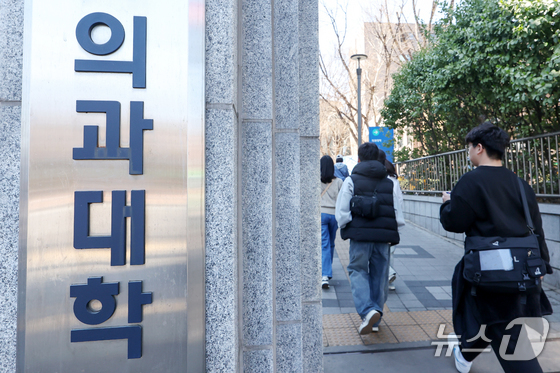
The Ministry of Education’s recent evaluation, conducted after the expansion of medical school enrollment for the 2025 academic year, has revealed significant challenges in faculty staffing and educational facilities at several universities. This development has brought to the forefront concerns about the strain on educational infrastructure due to increased medical student numbers.
According to the Ministry, the Korea Institute of Medical Education and Evaluation (KIMEE) issued a provisional non-accreditation status to Konkuk University, Dongguk University, and Hallym University on Monday. Jeonbuk National University, facing a similar outcome, has appealed the decision and is currently undergoing a review process.
This assessment primarily targeted universities that had implemented substantial enrollment increases, aiming to examine the resulting changes in educational conditions. Approximately 30 out of the nation’s 40 medical schools were included in the evaluation, excluding those with enrollment increases below 10%.
This inaugural evaluation since the enrollment expansion has exposed faculty and facility shortages at certain institutions, underscoring the practical challenges of the policy.
The provisional non-accreditation status allows these universities to maintain their accreditation temporarily. However, failure to address the identified issues within a year could result in a final non-accreditation decision, potentially leading to a suspension of new student admissions. The probationary period extends from March 1 of this year to February 18 of the next.
Specific issues varied among universities. Hallym University faces a shortage of parasitology faculty, while Dongguk University needs to secure pathology faculty and increase its clinical medicine professors. Konkuk University received recommendations to bolster its clinical faculty, particularly at Chungju Hospital.
Jeonbuk National University reportedly grapples with both faculty shortages and insufficient educational spaces, including classrooms. The situation is exacerbated by the doubling effect, where students from both the 2024 and 2025 cohorts are attending classes simultaneously, significantly increasing the educational burden.
A Ministry of Education spokesperson acknowledged these challenges, stating that some universities are experiencing difficulties in maintaining adequate educational conditions, especially with the concurrent attendance of 2024 and 2025 cohorts. In some cases, these issues are extensions of pre-existing problems at institutions that already had high student numbers before the expansion.
These findings substantiate the concerns raised during the policy’s implementation regarding potential shortages in educational infrastructure.
The government’s push to expand medical school enrollments aims to address physician shortages and mitigate regional healthcare disparities.
Following the February 2024 announcement of the expansion policy, the Korean Council for University Education approved modifications to the 2025 college admissions process in May, resulting in a substantial increase of 1,509 students across the nation’s medical schools compared to the previous year.
In conjunction with this expansion, the government is working on allocating regional physician quotas to medical schools, aligning with the regional physician selection system set to launch in 2027. The Health and Welfare Ministry’s Health Policy Advisory Committee has decided to designate all additional slots for regional physicians, planning to add 490 new students in 2027 and 613 annually from 2028 to 2031.
However, the confirmation of faculty and facility shortages at some universities during this evaluation has intensified concerns about the strain on educational infrastructure, a point of contention throughout the policy’s implementation.
The Korean Medical Association has voiced strong opposition, arguing that decisions focused solely on increasing numbers could lead to the deterioration of medical education quality. They warn that inadequate classroom and practical training environments may result in substandard education.
The association particularly emphasized the potential doubling effect, where returning students from military service could coincide with increased enrollment, creating an unsustainable burden on educational resources.
Looking ahead, the introduction of the regional physician selection system in 2027 may further complicate matters for regional medical schools, which will need to manage both increased enrollment and expanded selection of local talents simultaneously.
Critics argue that for the medical school enrollment expansion and regional physician policy to be truly effective, policymakers must address fundamental infrastructure improvements. This includes not only increasing student numbers but also securing adequate faculty and expanding educational facilities.
Responding to these concerns, a Ministry of Education representative stated that it is acutely aware of the challenges faced by certain universities. As soon as enrollment numbers are finalized, it will collaborate with the universities and financial authorities to enhance the educational environment.