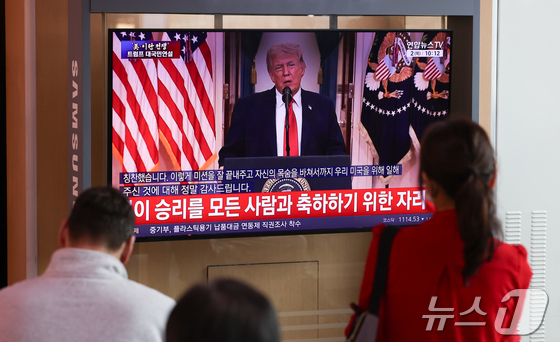
President Donald Trump’s announcement of sustained strikes against Iran for two to three weeks has poured cold water on the semiconductor investment sentiment that had been buoyed by hopes for peace. The upcoming earnings reports from industry giants Samsung Electronics and SK hynix, coinciding with Trump’s timeline, are poised to be a watershed moment for market sentiment.
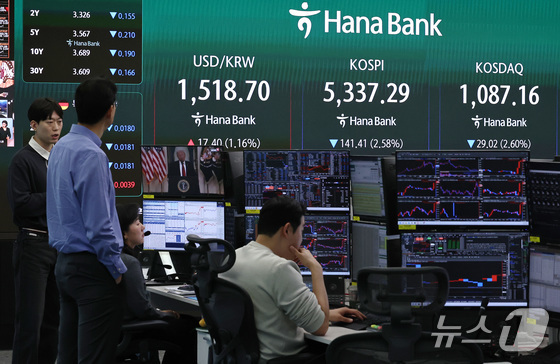
As of 3:00 p.m (South Korean time) on Thursday, the Korea Exchange reported Samsung Electronics’ stock price had plummeted by 14,200 KRW (abuot 9.41 USD) (7.49%) to 175,400 KRW (about 116.2 USD). SK hynix wasn’t spared, trading down 74,000 KRW (about 49.02 USD) (8.29%) at 819,000 KRW (about 542.62 USD).
Both companies saw their stocks rise at the opening bell. However, the tide turned sharply bearish around 10:00 a.m. (South Korean time), immediately following Trump’s address to the nation, with losses mounting as the day progressed.
The previous day, Samsung Electronics and SK hynix had surged 13.40% and 10.66% respectively, riding a wave of optimism about a potential end to the Middle East conflict. Trump’s declaration of a focused offensive against Iran over the next two to three weeks appears to have rekindled risk aversion among investors.
Prior to Trump’s speech, global semiconductor investment sentiment had been on an upswing. While the President couldn’t pinpoint an exact end date for the Iran conflict, his assertion that it will move out quite quickly had fueled hopes for a swift resolution.
This optimism was reflected in the U.S. stock market on Wednesday, with Micron, the country’s largest dynamic random access memory (DRAM) manufacturer, skyrocketing 8.94%. SanDisk, the leading NAND memory producer, saw a 9.03% jump, while its parent company, Western Digital, surged 10.07%.
The rally wasn’t limited to memory companies. Industry heavyweights like Intel Corporation (8.84%), NVIDIA (0.75%), AMD (3.33%), Marvell (7.73%), and ARM (2.51%) all posted gains. Consequently, the Philadelphia Semiconductor Index surged 2.82% to 7,802.31 points.
The market’s initial shock reaction to Google’s TurboQuant announcement was also subsiding. Unveiled on March 26, TurboQuant is a groundbreaking technology that compresses the KV cache – the temporary memory of large language models (LLMs) – to a 3-bit level, slashing memory usage by approximately six times.
This innovation sparked concerns about a potential decline in memory demand, which had been soaring due to artificial intelligence (AI) infrastructure expansion. The news initially triggered a sharp sell-off in shares of global memory semiconductor firms, including Samsung Electronics and SK hynix.
However, some analysts argue these fears may be overblown. Kim Dong-won, head of research at KB Securities, draws an intriguing parallel to historical technological advancements: AI efficiency technologies like Google’s TurboQuant will lower barriers to entry in the AI inference market. Paradoxically, they’re likely to drive up computational demands and memory usage, accelerating overall AI demand. Kim likens this to the rebound effect seen in the 1860s, when improved steam engine efficiency actually increased coal demand, or in the 1990s, when the internet’s arrival led to a surge in paper consumption.
The semiconductor sector’s rebound now hinges on whether a genuine peace agreement materializes within Trump’s two to three-week timeline. This period coincides with the earnings season for major chip makers. TSMC, the world’s largest foundry, is set to report its Q1 results on April 16, while Samsung Electronics and SK hynix will release their finalized figures by month’s end.
Tech giants that drive AI semiconductor demand – Google, Microsoft, Amazon, and Meta – are also slated to report earnings from late April to early May. Strong results and optimistic forecasts from these companies could provide additional momentum, especially if coupled with progress towards peace.
According to FnGuide, market consensus for Samsung Electronics’ Q1 operating profit stands at 32.4681 trillion KRW (about 21.5 billion USD), while SK hynix is expected to report 31.1761 trillion KRW (about 20.6 billion USD).
Chae Min-sook, an analyst at Korea Investment & Securities, offers a bullish perspective: Memory contract prices are surging, independent of spot prices. It’s not just talking about quarter-over-quarter or year-over-year growth. DRAM prices are hitting all-time highs, fundamentally altering the profit landscape for memory manufacturers compared to historical norms.