The government clarified concerns about the announcement of the Jangbogo-N Project, the basic plan for introducing nuclear-powered submarines, stating that there was prior communication and consensus with the U.S.
During a regular briefing on Thursday, Defense Ministry spokesperson Jeong Bit-na addressed reporters’ concerns about potential negative U.S. reactions to Korea’s announcement without prior coordination, saying that the U.S. and Korea have formed a consensus on the need to begin negotiations promptly.
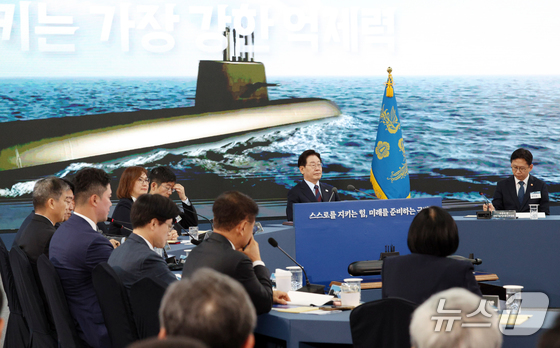
Earlier, on Tuesday, Defense Minister Ahn Gyu-back presented the Basic Plan for Developing South Korean Nuclear-Powered Submarines, which includes five key development principles, at the Future Defense Strategy Committee meeting chaired by President Lee Jae Myung in Jinhae, Gyeongsangnam-do.
The five main development principles are: using low-enriched uranium with less than 20% enrichment, developing and building within the Republic of Korea, utilizing Korean reactor and shipbuilding technology, ensuring safety management throughout the entire lifecycle from construction to decommissioning, and aiming to launch the first submarine by the mid-2030s. In his announcement, Minister Ahn also outlined plans to develop and construct the nuclear-powered submarines domestically.
Some have questioned whether Korea’s nuclear power technology is advanced enough for independent development and construction of nuclear-powered submarines, and whether this announcement was made unilaterally without practical discussions following the U.S.-Korea summit last October.
Addressing these concerns, spokesperson Jeong stated that Korea has already demonstrated its capability to manage the entire cycle from reactor design to construction and operation through numerous domestic and international nuclear power plant projects. It’s also actively developing small reactors for civilian use. The government believes that if it develops and apply specialized technologies needed for military environments, such as low noise and low vibration, it’s entirely feasible to develop reactors for nuclear-powered submarines. Combined with the submarine construction expertise, proven through building 3,000-ton conventional submarines, it believes it can achieve nuclear-powered submarine development and construction in a relatively short timeframe.
She added that the introduction of nuclear-powered submarines was agreed upon by the leaders. Specific details will be discussed once practical negotiations begin. It plans to negotiate with the U.S. primarily regarding nuclear fuel, based on the premise that it will construct the submarines using the own technology.
When asked if the Korean government’s announcement of the basic plan for nuclear-powered submarines was premature, spokesperson Jeong replied that the notion of being hasty is quite subjective. The government has spent five months developing this basic plan in collaboration with relevant departments and has transparently shared it with the public. She disagrees with the suggestion that it’s premature.
Park Il, spokesperson for the Ministry of Foreign Affairs, also stated during a regular briefing that they’ve had sufficient prior communication and coordination with the U.S. side regarding the basic plan for nuclear-powered submarines, including goals and timelines. It will have detailed discussions on various issues with the upcoming U.S. delegation visiting Korea.
The U.S. and South Korea plan to hold a kickoff meeting in mid-June to implement the security agreements outlined in the Joint Fact Sheet (JFS) announced after last year’s U.S.-Korea summit, which includes the introduction of nuclear-powered submarines and the revision of the Nuclear Cooperation Agreement.