

The South Korean government has agreed to strengthen its energy and critical mineral supply chain cooperation with Canada. They plan to increase Canadian crude oil imports from 4.88 million barrels last year to up to 16 million barrels this year.
The two nations also agreed to enhance collaboration across the energy and resources sectors, including expanding liquefied natural gas (LNG) projects, cooperating on critical mineral supply chains, and establishing a joint stockpiling system.
On Tuesday, the Ministry of Trade, Industry, and Energy announced that it co-hosted the Korea-Canada Energy Resource Supply Chain Cooperation Forum in Ottawa with Canada’s Ministry of Natural Resources. The forum focused on stabilizing cooperation in crude oil, LNG, and critical mineral supply chains.
Both countries agreed to expand their resource cooperation from a simple buyer-supplier relationship to a comprehensive partnership integrating technology and capital.
The forum, coinciding with the activities of Special Envoy for Strategic Economic Cooperation Kang Hoon-sik (Chief of Staff to the President), featured presentations from Canadian federal and provincial governments on resource-related investment and policy environments. Korean companies outlined their cooperation strategies and on-the-ground needs.
Canadian Crude Oil Imports to Increase From 4.88 Million to 16 Million Barrels; LNG Cooperation to be Strengthened
In the crude oil sector, South Korea plans to increase its imports of Canadian crude from 4.88 million barrels in 2025 to up to 16 million barrels in 2026, more than tripling the volume. The two countries aim to explore ways to further increase the annual import volume to up to 20 million barrels.
This move would make South Korea the third-largest destination for Canadian crude oil, after the U.S. and China. It allows South Korea to diversify its oil sources while helping Canada reduce its heavy reliance on the U.S. market, which currently receives over 90% of Canada’s crude oil exports.
In the LNG sector, discussions centered on Korea Gas Corporation’s potential participation in the second phase of the Canada LNG Project, where it currently holds a 5% stake and imports 700,000 tons annually.
The goal is to finalize investment decisions for this phase by the third quarter of 2026. If the new Ksi Lisims project, which plans to import an additional 2 million tons annually, is also incorporated, South Korea could secure a stable supply of 3.4 million tons of Canadian LNG each year.
Expansion of Critical Mineral Supply Chain and Stockpiling Cooperation; Close Collaboration in Space and Defense Industries
The forum also addressed expanding cooperation in critical mineral supply chains between Canada, a leading global producer, and South Korea, a major global demand center due to its manufacturing sector.
Currently, Canada is South Korea’s third-largest source of mineral imports, after Australia and Indonesia. South Korean companies have announced plans to purchase Canadian minerals worth 9.03 billion CAD (about 6.49 billion USD), including lithium, rare earths, nickel, and copper concentrate, along with intentions to invest 130 million CAD (about 93.5 million USD) in graphite mining.
Based on their complementary industrial structures, both countries agreed to actively support increased investment and purchasing between businesses while continuing discussions on policy measures to ensure supply stability.
Notably, following the agreement on joint critical mineral stockpiling during a May 8 phone call between the two nations’ leaders, the South Korean Ministry of Industry and Canada’s Ministry of Natural Resources will develop a joint stockpiling plan by year-end.
Additionally, the forum saw the signing of a memorandum of understanding (MOU) between the Korea Institute of Geoscience and Mineral Resources and the Geological Survey of Canada (GSC). They will collaborate on a Natural Hydrogen Joint Research Implementation Agreement to proactively secure a supply chain for carbon-free, cost-effective natural hydrogen.
Lastly, both governments and the Korea Trade-Investment Promotion Agency (KOTRA) committed to supporting the smooth implementation of cooperation in energy and resource areas, including crude oil, LNG, and critical minerals, while addressing challenges faced by businesses on the ground.
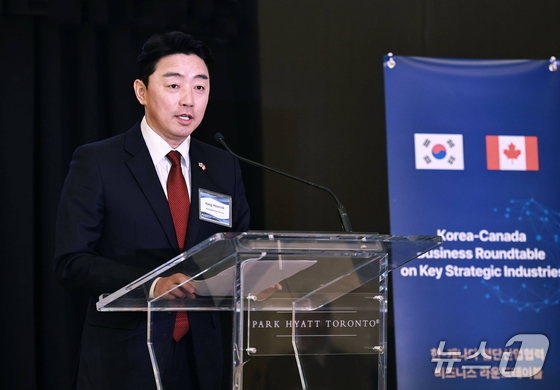
On Monday, the two nations held a Korea-Canada Advanced Industry Cooperation Business Roundtable (BRT) to strengthen collaboration in advanced and strategic industries.
The event resulted in three MOUs between companies from both countries in the aerospace and defense sectors, covering satellite communications, launch sites, and defense vehicles.
During the roundtable, Hanwha presented defense and aerospace cooperation plans, while Hyundai Motor Company outlined its hydrogen collaboration strategies.