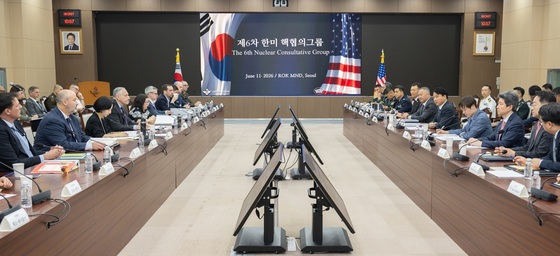
On Thursday, the U.S. and South Korea convened the sixth meeting of the Nuclear Consultative Group (NCG) in Seoul. The focus was on advancing discussions about the U.S.-South Korea nuclear and conventional integration (CNI) strategy.
The Pentagon released a joint press statement following the meeting. It highlighted that both nations reviewed key NCG objectives, including enhancing security protocols, improving information sharing, refining consultation procedures for nuclear crises, furthering U.S.-South Korea CNI efforts, bolstering joint exercises, fine-tuning strategic messaging, and implementing threat reduction measures. The talks centered on strengthening the alliance’s nuclear deterrence capabilities and overall readiness posture.
Military officials from both countries assessed ongoing efforts to develop the U.S.-South Korea CNI framework, which aims to counter North Korea’s nuclear threats. They committed to continued advancement in this area. The representatives also signed the U.S.-South Korea NCG Security Guidelines, a crucial step in safeguarding sensitive information related to NCG activities and consultations.
The CNI concept outlines a strategy where the U.S. takes the lead on nuclear operations, with South Korea providing support through conventional forces. This approach has been refined through previous NCG meetings and the U.S.-South Korea Security Consultative Meeting (SCM). Notably, the joint statement from the fifth NCG meeting in Washington, D.C. last December emphasized South Korea’s leading role in conventional defense on the Korean Peninsula.
In light of North Korea’s advancing nuclear and missile capabilities and the evolving security landscape, both nations agreed to further enhance NCG activities. This move aims to reinforce the alliance and bolster extended deterrence measures. The partners reaffirmed their shared commitment to North Korean denuclearization. The U.S. delegation reiterated its pledge to provide extended deterrence to South Korea, leveraging its full spectrum of capabilities, including nuclear assets.
The officials agreed to brief their respective defense ministers on the NCG outcomes during the upcoming 58th SCM. They also greenlit the NCG’s agenda for the latter half of 2026, including plans for the seventh meeting.
Notably, the joint statement did not address the early transfer of wartime operational control (OPCON). The South Korean Ministry of National Defense maintains that while determining nuclear use authority post-OPCON transfer is crucial, this issue remains separate from the U.S. commitment to nuclear deterrence.
The meeting was co-chaired by Kim Hong-chul, Director General for Defense Policy at South Korea’s Ministry of National Defense, and Dr. Robert Soofer, Deputy Assistant Secretary of Defense for Nuclear and Missile Defense Policy. It included participation from defense, diplomatic, and intelligence officials from both nations.
The NCG was established in April 2023 as part of the Washington Declaration between the U.S. and South Korea. Its primary purpose is to facilitate South Korea’s involvement in discussions pertaining to U.S. nuclear operations, specifically in response to North Korea’s nuclear threats.