

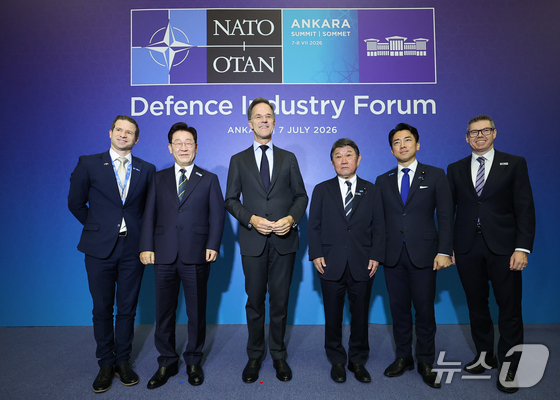
President Lee Jae Myung, currently in Turkey for the North Atlantic Treaty Organization (NATO) summit, is intensifying his defense sales diplomacy efforts on Wednesday.
As he pursues a series of bilateral meetings with nations showing high interest in defense cooperation, speculation mounts about potential encounters with U.S. President Donald Trump and Ukrainian President Volodymyr Zelenskyy.
The Blue House reports that on Wednesday, the second day of the NATO summit, President Lee will engage in bilateral talks primarily with countries seeking practical cooperation, especially in defense.
His agenda focuses on expanding exports for South Korean defense firms and establishing a foothold in NATO’s supply chain through discussions and informal meetings with leaders interested in defense and other collaborative areas.
President Lee’s schedule includes meetings with the leaders of Norway, the Netherlands, and Romania. Sources indicate that the Foreign Ministry is coordinating additional talks with other NATO member states.
NATO members, accounting for roughly 55% of global defense spending, are substantially increasing their military budgets in response to evolving security challenges. Seoul aims to leverage this expansion, seeing NATO as the world’s largest defense market, to broaden export opportunities for its defense industry.
At the NATO defense industry forum, President Lee proposed elevating the Korea-NATO Defense Industry Partnership 2.0, advocating for joint production, research, and operations beyond mere arms transactions. This move signals South Korea’s ambition to integrate into NATO’s defense market and supply chain.
Progress was also made in addressing the defense industry’s long-standing requests for NATO standard information sharing and stronger institutional cooperation. During talks with NATO Secretary General Mark Rutte, both parties announced the start of negotiations for a basic procurement agreement with NATO.
National Security Office Director Wi Sun-lac explained that once finalized, this agreement will create a legal framework for South Korean companies to participate in NATO’s joint procurement market, estimated at 15 trillion KRW (about 9.95 billion USD) annually. He added that South Korea will expand its observer role in NATO’s multinational cooperation projects, joining defense and raw materials initiatives alongside existing involvement in ammunition and space programs.
Building on President Lee’s diplomatic achievements at the summit, the government plans to actively support South Korean companies’ integration into NATO’s supply chain. They also aim to deepen engagement in NATO’s innovation network and expand collaborative research and development (R&D) in critical future warfare technologies, including drones and space systems.
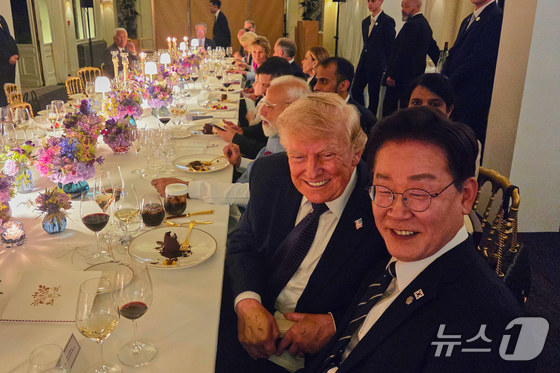
There’s speculation about a potential encounter between President Lee and President Trump, just weeks after their meeting at the Group of Seven (G7) summit.
Observers are keen to see if they’ll discuss recent U.S.-South Korea issues, including the Coupang matter and follow-up talks on the joint security fact sheet.
However, given the strained U.S.-NATO relations due to the Russia-Ukraine conflict, Middle East tensions, and trade disputes, President Trump has shown reluctance towards the NATO summit. The likelihood of a formal bilateral meeting seems low, considering their recent in-depth discussion at the G7 summit dinner.
Another point of interest is whether President Lee will meet face-to-face with Ukrainian President Zelenskyy for the first time. South Korea has pledged a 100 million USD non-lethal aid package to Ukraine in conjunction with the NATO summit.
If a South Korea-Ukraine summit materializes, President Lee is expected to express hopes for a swift end to the conflict, while President Zelenskyy will likely convey gratitude for South Korea’s support and discuss future cooperation.
Following the NATO summit, President Lee will embark on a state visit to Mongolia starting July 9, marking the first such visit by a South Korean president in 15 years.
The South Korea-Mongolia summit will focus on practical cooperation in key areas including critical minerals, food security, yellow dust mitigation, and advancements in health and science technology.
Given Mongolia’s friendly ties with North Korea, the South Korean government also plans to explore avenues for restarting dialogue with Pyongyang during this visit.