On Tuesday, observers noted that the recent nuclear cooperation agreement between the U.S. and Saudi Arabia does not grant Saudi Arabia independent uranium enrichment rights. As a result, the government believes this will have minimal direct impact on the upcoming U.S.-South Korea negotiations regarding enrichment and reprocessing (nuclear agreement revision talks).
U.S. Unlikely to Grant Saudi Arabia Independent Uranium Enrichment Rights… Not the Model South Korea Pursues
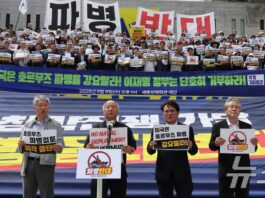
During a press briefing at the Ministry of Foreign Affairs in Seoul’s Jongno district, an official stated that while there’s significant interest in Saudi Arabia’s potential enrichment rights, current media reports and discussions suggest it’s premature to conclude that independent enrichment rights have been granted.
The official noted that providing a clear explanation is challenging since the U.S.-Saudi agreement text remains unpublished. According to foreign media, the U.S. and Saudi Arabia plan to jointly study uranium enrichment’s commercial viability for two years. Even if the study validates the need for uranium enrichment in Saudi nuclear plants, foreign media speculate this will involve a black box approach (where Saudi Arabia can’t directly access technology and operations, even with facilities in place).
The official explained that based on these reports, while the black box approach aligns with uranium enrichment within Saudi Arabia, it’s hard to view it as granting Saudi Arabia independent enrichment rights. Current reports suggest that if enrichment’s commercial viability isn’t recognized, Saudi Arabia can’t pursue independent enrichment or collaborate with a third country for ten years.
If the U.S.-Saudi agreement indeed follows the black box approach, uranium enrichment could occur on Saudi soil, but Saudi Arabia wouldn’t fully acquire related technology from the U.S. or operate facilities independently.
Saudi Arabia won’t be exempt from safety measures. While it appears Saudi Arabia hasn’t agreed to join the International Atomic Energy Agency (IAEA) Additional Protocol (AP), it seems to have secured external oversight through a separate bilateral safety agreement with the U.S.
The official stated that while specific details and IAEA involvement levels are currently unclear, it expects safety measures to be included, considering U.S. non-proliferation standards and congressional review.
In this context, the government assesses that the recent U.S.-Saudi agreement has little direct relevance to the South Korea-U.S. nuclear negotiations. South Korea can already engage in some uranium enrichment with U.S. approval under the existing bilateral nuclear agreement. Moreover, the differing civilian nuclear industry and technology levels between South Korea and Saudi Arabia make the Saudi approach irrelevant for South Korea.
A foreign ministry official remarked that given the disparities in civilian nuclear industry development between South Korea and Saudi Arabia, it’s challenging to directly assess the impact on the U.S.-South Korea enrichment and reprocessing negotiations.
A Subtle Shift in U.S. Nonproliferation Policy? Seizing Opportunities to Counter China and Russia
However, the government sees both opportunities and challenges in the indirect influence of the U.S.-Saudi nuclear agreement on U.S.-South Korea negotiations.
Analysts suggest that the U.S. concluded this nuclear agreement with Saudi Arabia, balancing commercial interests in nuclear power exports and strategic considerations to counter China and Russia, while adhering to existing non-proliferation principles. This could positively influence negotiations to expand South Korea’s uranium enrichment and spent fuel reprocessing rights.
Recently, the U.S. signed a memorandum of cooperation (MOC) with South Korea, known for its nuclear technology expertise, and Japan, renowned for its precision technology, to enter the small modular reactor (SMR) market, where Russia and China currently lead.
The official observed that this U.S.-Saudi agreement appears to emphasize commercial cooperation between the two countries, adding that the U.S. Department of Energy’s announcement highlighted the groundwork laid for U.S. companies to participate in Saudi nuclear projects.
The official further noted that the U.S.-South Korea negotiation team is also mindful of the Donald Trump administration’s recent tendency to consider commercial and strategic aspects in foreign nuclear cooperation.
Conversely, the U.S. requiring Saudi Arabia to conduct joint research over two years and applying a black box approach, even if allowing enrichment within Saudi Arabia, demonstrates a strict management attitude toward Saudi Arabia’s enrichment capabilities.
The establishment of a separate bilateral safety agreement also indicates that the U.S. maintains a strong non-proliferation control stance, suggesting that strict standards will likely continue for South Korea as well. Considering these factors, the government is approaching the U.S.-South Korea negotiations with caution.