The U.S. Department of Defense has reaffirmed its stance that South Korea must meet the agreed-upon conditions for the swift transfer of wartime operational control (OPCON), as proposed by President Lee Jae Myung. The Pentagon emphasized that its official position aligns with the U.S. side and stated its commitment to ongoing close consultations.
According to a Voice of America (VOA) report on Tuesday, the Pentagon responded to VOA’s written inquiries about the OPCON transfer, stating that the transition remains a process based on mutually agreed conditions between the U.S. and South Korea.
The Defense Department added that both nations continue to agree that the necessary conditions must be met before the transfer occurs, and stated that it will not speculate on the decisions or outcomes of this bilateral process.
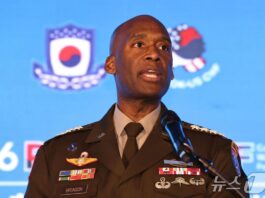
This response came in the wake of President Lee’s remarks about an early OPCON transfer and U.S. Forces Korea Commander General Xavier Brunson’s comments on changes to the transfer conditions.
The previous day, President Lee met with reporters at the Blue House press room and stated that regarding OPCON, it must be swiftly returned. U.S.-South Korea discussions are fundamentally moving in the direction of its return.
President Lee also emphasized that OPCON should be referred to as a recovery or restoration rather than a transfer, suggesting that South Korea has sufficient conventional military strength to lead its own defense.
The U.S., while not denying the necessity of OPCON transfer, has essentially reaffirmed its existing principle that the conditions agreed upon by both nations must be met.
A military official stated that the U.S. and South Korea are continuing consultations based on the mutually agreed Captain of the Port (COTP), adding that this aligns with the Defense Department’s official position. While there may be some differences at the military level, as with any negotiation, these are issues that the U.S. and South Korea will resolve through discussion.
The official continued that future military consultations will include the Permanent Military Committee (PMC) between the U.S. and South Korean Joint Chiefs of Staff, the Military Committee Meeting (MCM), as well as policy consultations between defense ministers through the Security Consultative Meeting (SCM), emphasizing that close consultations are ongoing.
Since 2014, the U.S. and South Korea have been proceeding with the OPCON transfer based on the Conditions-based Operational Control Transition Plan (COTP). The conditions include: 1) South Korea’s military capabilities necessary to lead combined defense, 2) the alliance’s comprehensive ability to counter North Korea’s nuclear and missile threats, and 3) a security environment on the Korean Peninsula and in the region that supports a stable OPCON transition.
It’s noteworthy that the Pentagon’s response came shortly after General Brunson’s recent remarks about changes to the OPCON transfer conditions.
On October 14, during a seminar in Washington, D.C., General Brunson mentioned North Korea’s recent missile launches, stating that conditions have changed, and it has new standards to meet because it has altered the plans.
This led to speculation that the evaluation criteria for OPCON transfer might have shifted due to changes in the security environment, such as North Korea’s advancing nuclear and missile capabilities.
However, in this response, the Pentagon did not elaborate on the specific changes mentioned by General Brunson or whether there had been any actual modifications to the existing transfer conditions or evaluation criteria.