

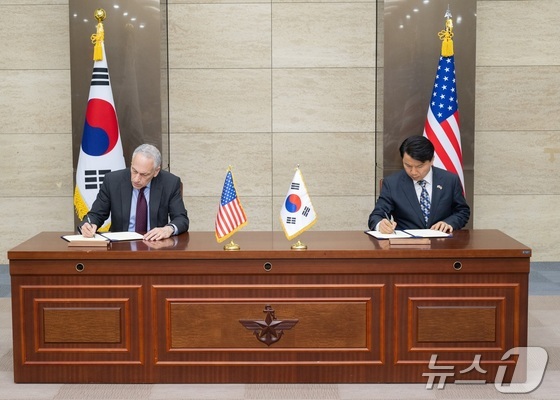
Experts are calling for the enhancement of the U.S.-South Korea Nuclear Consultative Group (NCG) by drawing lessons from the North Atlantic Treaty Organization’s (NATO) Nuclear Planning Group (NPG). This recommendation comes in response to the growing military cooperation between North Korea and Russia, which is bolstering North Korea’s modern warfare capabilities and accelerating technology transfers from Russia.
In a report titled, NATO’s Strategic Adaptation and Changes in Nuclear Deterrence Posture in the Multi-Theater Era, released on Friday, Yang Wook, a researcher at the Asan Institute for Policy Studies, and Son Han-byeol, a professor at Korea National Defense University, highlighted that the U.S. is facing an unprecedented strategic challenge. For the first time in history, the U.S. must simultaneously confront two major nuclear rivals: Russia and China.
The report argues that U.S. nuclear strategy must evolve from a single-theater focus to managing multiple theaters concurrently. In the event of gaps in U.S. strategic asset deployment, the authors propose filling these voids through a multilateral networked deterrence approach.
European nations are reinforcing their collective defense systems while also forging alliances with key Indo-Pacific countries like South Korea and Japan to establish inter-regional linked deterrence. While maintaining security ties with NATO and the U.S., Europe is proactively preparing for potential nuclear deterrence gaps by exploring the use of independent nuclear capabilities, such as those of France, to complement U.S. resources if needed.
The report suggests that Europe’s strategy could serve as a crucial model for the future direction of the U.S.-South Korea NCG. Launched in July 2023 under the Yoon Suk Yeol administration to bolster extended deterrence, the NCG is in its early stages of developing nuclear-conventional integration (CNI) operational concepts and regularizing exercises. The authors stress the need to swiftly institutionalize nuclear deterrence procedures, including planning, exercises, and crisis management, by learning from NATO’s NPG.
Since its establishment in the 1960s during the Cold War, NATO’s NPG has systematically implemented joint nuclear planning, crisis management protocols, regular nuclear exercises, and a nuclear sharing system using dual-capable aircraft (DCA). The report advocates benchmarking this proven model to enhance U.S.-South Korea extended deterrence.
The report emphasizes that NATO’s primary challenge lies not in expanding its nuclear arsenal, but in enhancing the credibility and sustainability of U.S. extended deterrence. It notes that South Korea, also relying on the U.S. nuclear umbrella, faces similar structural conditions. The U.S.-South Korea NCG is viewed as a crucial institutional starting point to address these challenges.
In light of North Korea’s rapid adoption of new operational concepts such as AI, drones, and long-range precision strikes following the Russia-Ukraine conflict, the report recommends evolving the U.S.-South Korea alliance into a combined CNI-based deterrence system.
The authors conclude that security policies focused solely on the Korean Peninsula are no longer sufficient in a world where the U.S. must manage multiple theaters. They urge South Korea to regularize policy consultations, strategic dialogues, joint war games, nuclear crisis response discussions, and cyber and space security cooperation with NATO. Furthermore, they suggest exploring long-term strategies to develop the NPG, NCG, and U.S.-South Korea-Japan security cooperation framework in a mutually reinforcing manner.