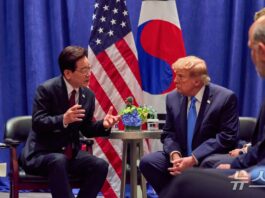
President Donald Trump is intensifying pressure ahead of the midterm elections by showcasing foreign investments in the U.S. as part of his economic accomplishments. While the first project related to these investments has been announced, the schedule for follow-up discussions between South Korea and the U.S. regarding nuclear-powered submarines, uranium enrichment, and spent nuclear fuel reprocessing remains unset.
There are growing concerns that delays in U.S. investments, which have previously impeded security talks, could further postpone negotiations on additional investment issues. The government faces the challenge of linking agreed-upon investments to progress in security cooperation while maintaining commercial principles for projects not yet finalized.
Diplomatic sources reported on Monday that President Trump recently warned of potential tariffs up to 300% on foreign companies that don’t build factories in the U.S. He has essentially confirmed the investment in Alaska’s liquefied natural gas (LNG) project after assessing its commercial viability and even mentioned an 8.4 billion USD oil project in the U.S. that wasn’t included in the publicly released agreements.
This approach seems aimed at emphasizing his success in revitalizing American manufacturing and job creation as key achievements before the midterms. As the elections draw closer, the discrepancy between official agreements and Trump’s claims about South Korea’s investment promises could lead to additional demands on South Korea.
Investment Pressure Intensifies… But Could Also Provide Leverage to Advance Security Negotiations
The government is currently pursuing follow-up discussions on security issues addressed during last year’s summit, including the introduction of conventional armed nuclear submarines, peaceful uranium enrichment, spent nuclear fuel reprocessing, and the transfer of operational control.
The introduction of nuclear submarines and nuclear cooperation were included in the joint fact sheet released after the November summit last year. The U.S. agreed to approve South Korea’s construction of nuclear submarines and discuss nuclear fuel procurement methods. They also decided to expand authority for peaceful uranium enrichment and spent fuel reprocessing, within U.S. legal limits.
However, the first working-level discussions, initially scheduled for January, didn’t occur until June 2 in Seoul. The follow-up talks planned for July in Washington have yet to be scheduled. The practical discussions needed to implement the leaders’ agreements have not gained momentum.
A senior Foreign Ministry official stated on October 2 that discussions on nuclear submarines and the nuclear agreement haven’t progressed as expected. However, he noted that the atmosphere shifted following last month’s summit. They plan to initiate follow-up discussions soon to expedite progress.
Analysts suggest that since trade and security issues were addressed comprehensively during last year’s summits, recent investment project advancements could drive security negotiations. As South Korea demonstrates results in desired investment areas, it may also seek U.S. cooperation on issues important to South Korea.
Professor Min Jeong-hoon from the National Diplomatic Academy told News1 that the U.S. prioritizes large-scale investments from South Korea in the trade package, and it aims to fulfill these while securing what it wants from the security package. As investments in the U.S. progress, it creates momentum for advancements in security negotiations.
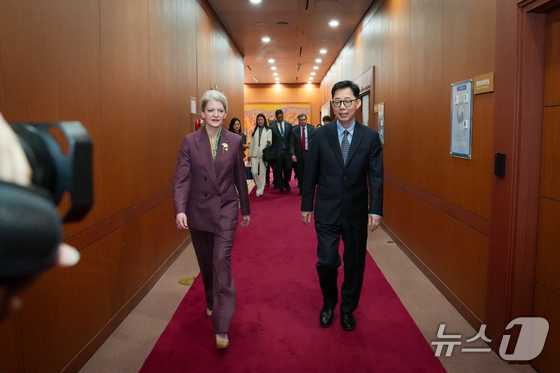
The government must distinguish between confirmed investments, projects under review, and claims not in public agreements. It should implement agreed investments while assessing unconfirmed projects’ commercial viability and seek concrete U.S. responses on desired security cooperation.
The government currently downplays the potential for the Alaska LNG investment to hinder security discussions. A senior Foreign Ministry official stated on October 2 that the Alaska LNG issue is more about insufficient time to review commercial viability than disagreement, assessing that it’s unlikely to become contentious.
Since nuclear submarines and enrichment/reprocessing require U.S. institutional and policy cooperation, the task is to finalize follow-up discussion schedules and specific cooperation plans based on investment implementation. It’s crucial to prevent security discussion delays each time additional investment issues arise.
The transfer of operational control is already under discussion through separate defense channels based on agreed conditions. The government aims to determine a target year for the transfer by year-end, coinciding with the 58th Korea-U.S. Security Consultative Meeting in November. However, South Korea emphasizes swift transfer, while the U.S. focuses on meeting conditions, making U.S. cooperation crucial for setting the target year.
The U.S. also needs large-scale South Korean investments to expand manufacturing and create jobs, providing negotiation leverage for South Korea. Rather than assuming additional investment demands will immediately hinder security negotiations, Professor Min explains that South Korea can continue negotiations by demanding necessary security cooperation based on investment implementation.
Professor Min stated that it can’t agree to everything Trump demands, nor can it easily break the deal if it doesn’t comply. Since the U.S. also needs South Korean investments, it can continue negotiations by saying that it has done this much, so please give what it needs.