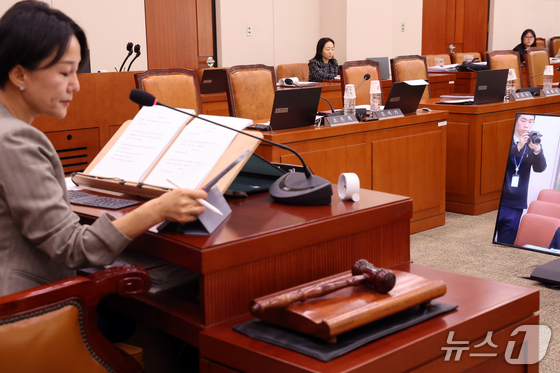
On October 23, during a National Assembly audit by the Culture, Sports, and Tourism Committee, political tensions flared once again over the global K-pop phenomenon FANOMENON.
The ruling People Power Party criticized the Democratic Party for not documenting the minutes of the Cultural Exchange Committee’s meetings. When Lee Jae-jung, the Democratic Party’s chair of the committee, mentioned the principle of non-disclosure for presidential records, the People Power Party accused her of distorting the inquiry and walked out en masse.
The committee conducted a comprehensive audit of the Ministry of Culture, Sports, and Tourism that day. From the outset, tensions escalated between the two parties regarding the viewing method of the amended trademark contract for the presidentially appointed Cultural Exchange Committee’s FANOMENON project.
Reports emerged late the previous night that the Cultural Exchange Committee had finalized a trademark amendment contract with JYP Entertainment.
People Power Party member Bae Hyun-jin stated that she was informed by the Cultural Exchange Committee that JYP Entertainment agreed to jointly hold all previously applied domestic and international trademarks with the government on a 50-50 basis, citing the need for expedience. They mandated the transfer of trademarks immediately after establishing a dedicated corporation.
Earlier in the audit, the opposition raised concerns about potential trademark monopolization and conflicts of interest after it was revealed that JYP Entertainment had filed for the FANOMENON-related trademark solely in its name.
People Power Party member Yoon Yong-geun pointed out that this morning, the Ministry of Culture stated that they modified the contract and agreed to allow us to view the amended contract, but there is no original document. Viewing means examining the original, not looking at a PDF copy.
In response, the committee chair referenced a previous incident during the audit when parts of the FANOMENON contract were exposed. He explained that management must be based on the premise of not disclosing it externally. However, due to situations that make it difficult to regain trust, it chose a compromise method of viewing.
Bae countered that this is not an external venue; it’s a national audit room. It didn’t expose the contract; it shared it within the national audit room. To say it can’t bring in something that might be an original or a copy out of fear of leaks is disrespectful to the public.
People Power Party’s floor leader Joo Eun-hee added that showing a photo isn’t a proper viewing method. The more we look into the budget involving taxpayer money, the more suspicious it becomes. It demands the contract be provided and want to see the original.
The debate over the FANOMENON project continued during the main questioning session.
Yoon Yong-geun questioned whether the failure to document minutes for the Cultural Exchange Committee’s subcommittee meetings violated the Presidential Records Act. Minister of Culture, Sports, and Tourism Choi Hwi-young responded that the operating rules regarding meeting records state that only plenary sessions need to be documented.
However, after Yoon’s inquiry, the committee chair explained the principle of non-disclosure for presidential records, which drew strong protests from People Power Party members.
The chair stated that meetings or reports conducted by presidential advisory bodies can be considered presidential records. Even before being officially designated as such, non-disclosure is the principle. He added that strictly adhering to this could lead to concerns about future presidential record designations, which could warrant non-disclosure.
He continued to mention to keep demanding disclosure and viewing, but strictly speaking, these could be withheld due to concerns about future designation as presidential records. Even committee members don’t have the authority to demand disclosure. Nevertheless, it’s communicating through this viewing method to maintain dialogue with it.
In response, People Power Party members strongly opposed the chair’s remarks, arguing that he distorted the intent of Yoon’s inquiry. As the chair attempted to continue the questioning amid the protests, the People Power Party members ultimately walked out.
Joo criticized that it cannot accept the chair’s unilateral management of the proceedings. It’s questioning why no records were kept for subcommittee meetings if they’re indeed national records, but the chair reframed it as a matter of disclosure.
The chair responded that sometimes there may be instances where the ruling party favors its own, but it has made every effort to avoid that and have been mindful to accommodate opposition members more. He added that if the opposition ignores the national audit and fails to properly exercise its authority, the public will be disappointed.