

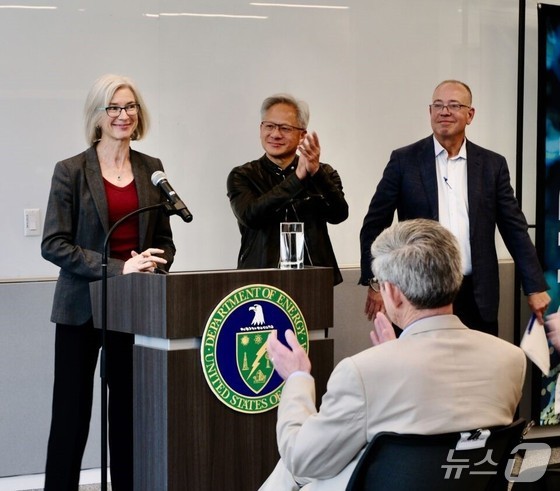
On Monday, NVIDIA and Dell Technologies announced their collaboration to build the next-generation supercomputer, Doudna, at the Lawrence Berkeley National Laboratory, under the U.S. Department of Energy.
Doudna is designed to support over 11,000 Department of Energy researchers in fields such as fusion energy, drug discovery, and astronomy. The team aims to have it fully operational by next year.
An NVIDIA spokesperson explained that by leveraging the latest Vera Rubin architecture and Dell’s liquid-cooled server infrastructure, Doudna will achieve performance more than ten times faster than current supercomputers, while consuming only two to three times the power. The representative added that Doudna is engineered as an integrated platform, combining high-performance computing (HPC), cutting-edge artificial intelligence (AI), real-time data streaming, and quantum workflows.
U.S. Energy Secretary Chris Wright stated that Doudna will elevate scientific discoveries in chemistry, physics, and biology to a new level.
The system is named after Jennifer Doudna, the 2020 Nobel Prize laureate in Chemistry and a pioneer of CRISPR technology.
Doudna will be connected in real-time to national research facilities through the Energy Sciences Network (ESnet).
NVIDIA’s Vera Rubin platform features a high-performance CPU-GPU architecture that enables direct data sharing and is optimized for various AI and quantum frameworks, including PyTorch, TensorFlow, and NVIDIA CUDA-Q.
NVIDIA reports that over 20 research teams are preparing Doudna-based workflows, which are expected to be utilized across diverse fields, from climate modeling to particle physics.
NVIDIA CEO Jensen Huang described Doudna as “a time machine for science,” saying that it compresses years of discoveries into days.
Nobel laureate Jennifer Doudna expressed her excitement, saying, “We’re standing at a really interesting moment in biology that marks the intersection of biology with computing,” and expressed hope that the Doudna supercomputer will contribute significantly to solving global challenges.