

Claims by Chinese smartphone manufacturers regarding ultra-thin foldable phones have proven to be misleading. Recent measurements reveal that some models are up to 0.6 mm (about 0.02 inches) thicker than advertised.
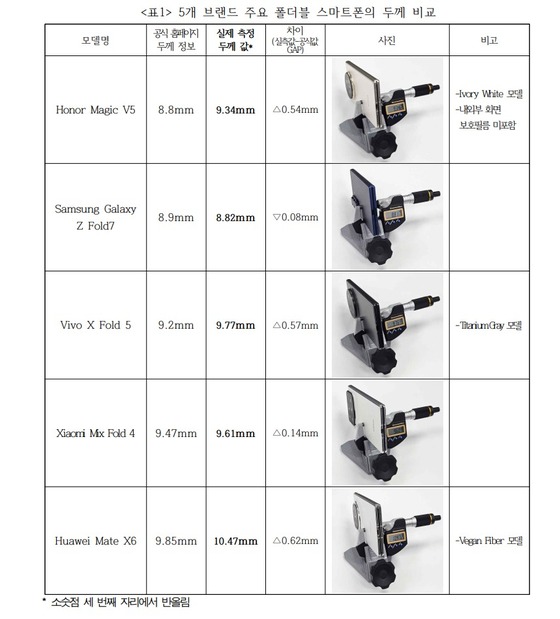
On Thursday, the Korea Consumer-centered Enterprise Association (KCEA) published their findings after measuring the thickness of major foldable phones. Using an external micrometer, they tested devices from Samsung Electronics, HONOR, Vivo, Xiaomi, and Huawei.
The KCEA selected the five most recent models available on the market, based on each brand’s market share.
HONOR’s Magic V5 in Ivory White, promoted as the world’s thinnest foldable phone, measured 9.34 mm (about 0.37 inches) thick—0.54 mm (about 0.02 inches) thicker than its advertised 8.8 mm (about 0.35 inches).
Huawei’s foldable phone exhibited the largest discrepancy. The Mate X6, claimed to be 9.85 mm (about 0.39 inches) thick, actually measured 10.47 mm (about 0.41 inches)—a significant 0.62 mm (about 0.02 inches) difference.
Foldable phones from Vivo and Xiaomi also did not meet their stated dimensions. The Vivo X Fold 5 measured 9.77 mm (about 0.38 inches), which is 0.57 mm (about 0.02 inches) thicker than its official specification of 9.2 mm (about 0.36 inches). Xiaomi’s MIX Fold 4 measured 9.61 mm (about 0.38 inches), 0.14 mm (about 0.006 inches) thicker than advertised.
In a surprising twist, Samsung Electronics’ Galaxy Z Fold 7 measured 8.82 mm (about 0.35 inches)—0.08 mm (about 0.003 inches) thinner than its official 8.9 mm (about 0.35 inches) thickness. This makes it the only global manufacturer’s foldable phone to actually break the 9 mm (about 0.35 inches) barrier.
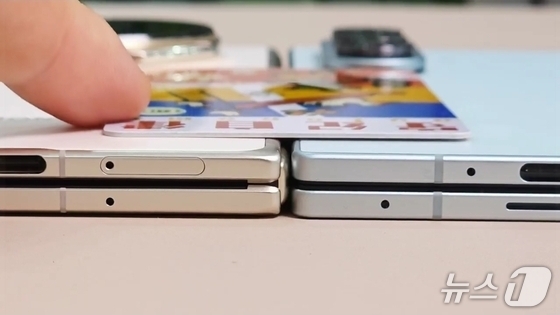
These discrepancies appear to stem from questionable techniques used by Chinese manufacturers.
For instance, HONOR stated on its website that the thickness measurements were based on its internal system and excluded the display’s protective film and camera module.
However, since foldable phones come with built-in protective films that consumers cannot remove, the advertised measurements do not reflect real-world usage. The KCEA’s measurements excluded camera protrusions and edges but included both the internal and external protective films.
The KCEA stressed that consumer information must provide accurate and comprehensive details about products available on the market. They noted that as the competition for slim designs intensifies—with differences as small as 0.1 mm (about 0.004 inches) being highlighted—companies should supply information on the final products that aligns with how consumers actually use them.