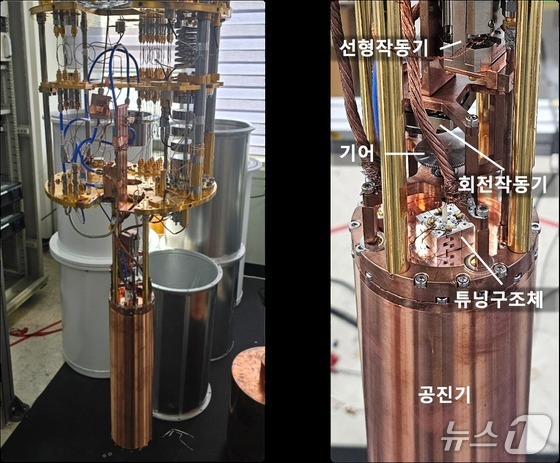
The Institute for Basic Science (IBS) announced on Thursday that a research team led by Dr. Yoon Seong-woo (Chief Investigator), head of the dark matter axion group, has successfully expanded their search for the promising dark matter candidate Axion into high-mass (high-frequency) regions while significantly improving sensitivity.
Dark matter is believed to constitute approximately 85% of the matter in the universe, yet it remains elusive due to its minimal interaction with light or other matter, making direct observation challenging.
Axions, a leading candidate for dark matter, were first proposed as theoretical particles in 1977. These extremely light, electrically neutral particles are difficult to detect directly. However, researchers can potentially capture their presence by converting their faint electromagnetic signals using strong magnetic fields and resonators. The challenge lies in the incredibly weak nature of these signals, making noise reduction crucial.
As the mass of axions increases, so does the signal frequency. This requires researchers to fine-tune their resonators across a wide range of frequencies, much like tuning a radio.
Until now, technical limitations have confined explorations primarily to lower mass (frequency) regions.
To overcome this, the research team developed a novel resonator employing a specialized electromagnetic wave resonance technique called higher-order resonant mode. This innovation allows for the detection of higher frequency signals in resonators of the same size as existing models, making it ideal for high-mass axion searches.
While the complex structure initially posed challenges in stabilizing the desired frequency for practical experiments, the team successfully addressed this issue by integrating a precision frequency tuning device of their own design.
The experiments were conducted in extreme conditions: a powerful magnetic field of 12 Tesla (T), 240,000 times stronger than Earth’s magnetic field, at a temperature of about -273.11 degrees Celsius (about -459.6 Fahrenheit), approximately 40 millikelvins, mK.
The team employed a Josephson parametric amplifier (JPA) to minimize signal noise and capture extremely weak signals. This groundbreaking approach allowed them to successfully implement the higher-order resonant mode search experiment for the first time in the frequency range of 5.079 to 5.171 gigahertz (GHz), corresponding to a mass range of 20.97 to 21.33 microelectronvolts (μeV).
This achievement is particularly significant as it demonstrates search performance approaching the predictions of the prominent KSVZ model of axion theory.
The KSVZ model theoretically predicts the strength of signals that should appear at specific mass ranges if axions exist. In their explored range, the research team achieved a sensitivity capable of detecting signals at about 1.7 times the theoretical predictions.
This level of sensitivity was previously unattainable due to technical constraints. It marks the first time that signal detection performance close to theoretical predictions has been achieved using higher-order resonant modes, bringing us a step closer to directly detecting axions.
Dr. Yoon, the study’s corresponding author, emphasized that expanding the axion search area is part of an ongoing effort to unravel the universe’s mysteries. He expressed hope that this research will serve as a crucial foundation for understanding dark matter and expanding the frontiers of human knowledge.
The findings of this groundbreaking study were published in the prestigious international physics journal Physical Review Letters.