
On Wednesday, Ewha Womans University announced a breakthrough in sensing technology. Professor Lee Sang-wook’s research team has developed a highly sensitive mass change-based sensor capable of detecting single microparticles and protein bindings.
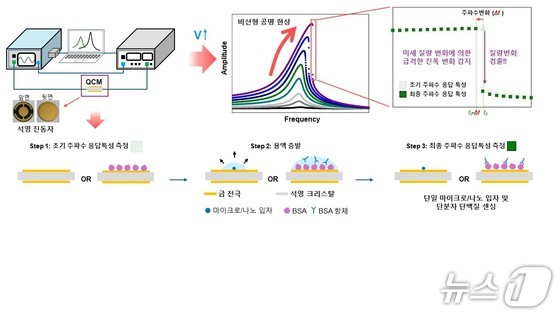
The team revolutionized the operation of quartz crystal microbalance (QCM) sensors by shifting from frequency change measurements to utilizing amplitude drops as signals. They significantly boosted sensor performance by harnessing non-linear resonance phenomena, previously considered undesirable.
Conventional QCM sensors rely on resonant frequency changes to detect minute mass variations. However, they struggle with extremely small mass changes, limiting their sensitivity.
To overcome this, the research team operated the sensor in the non-linear resonance region. They ingeniously used the sharp decrease in resonator amplitude under specific conditions as a new signal for minute mass changes.
This innovative approach allowed the team to measure mass changes as small as 100 femtograms (fg) and detect individual micro and nano particles, even single protein molecules. For context, a femtogram is one quadrillionth of a gram (10^-15 g).
The team also demonstrated that by leveraging non-linear resonance, they could reliably detect changes as small as 1 hertz (Hz), a significant improvement over the previous 1 kilohertz (kHz) threshold. They believe the sensor’s true potential sensitivity could be even higher.
What makes this development particularly noteworthy is that it enhances sensitivity simply by altering operating conditions of existing commercial QCM equipment. This approach ensures both reproducibility and practicality, unlike previous ultra-sensitive sensor technologies that required complex nanostructure fabrication or special materials.
The researchers envision wide-ranging applications for this technology, including ultra-fine dust detection, protein interaction analysis, ultra-sensitive harmful substance detection, and real-time biomolecule analysis. They’re especially excited about the potential for event-based sensing, which could enable high-speed, real-time analysis systems by allowing immediate reaction readings without frequency scanning.
Professor Lee emphasized that its research demonstrates how reinterpreting fundamental physical principles can lead to significant performance improvements. They’ve shown a way to use existing sensors more intelligently, rather than creating complex new ones.
This groundbreaking work was supported by several key initiatives, including the National Research Laboratory (NRL 2.0) project from the Ministry of Science and Information and Communications Technology (ICT), the Korea Research Foundation’s key research institute support project, the University ICT Research Center (ITRC) support project, and the Defense Technology Promotion Agency’s research on quantum computing and sensing technologies.
The team’s findings were published in the prestigious international journal Microsystems & Nanoengineering, which specializes in measurement and control technologies.