The Institute for Basic Science (IBS) announced on Thursday that a research team led by Hyeon Tae-ghwan from the Center for Nanoparticle Research has developed a technology that integrates experimental data from different water electrolysis catalyst materials into a single artificial intelligence (AI) model to discover novel catalyst groups and predict their performance.
Using this technology, the researchers explored catalysts for the oxygen evolution reaction necessary for green hydrogen production and experimentally verified that the newly predicted multi-metal single-atom catalyst outperformed all existing catalysts.
Water electrolysis is an environmentally friendly hydrogen production technology that generates hydrogen by splitting water using electricity. The accompanying oxygen evolution reaction in this process is slow and requires a substantial amount of energy. To improve this, developing high-performance catalysts that facilitate the reaction quickly and efficiently is crucial.
However, catalyst performance varies based on numerous factors such as constituent elements, atomic arrangements, and surface structures. In particular, the vast number of possible material combinations makes it challenging for researchers to find the optimal catalyst using only intuition and repeated experiments.
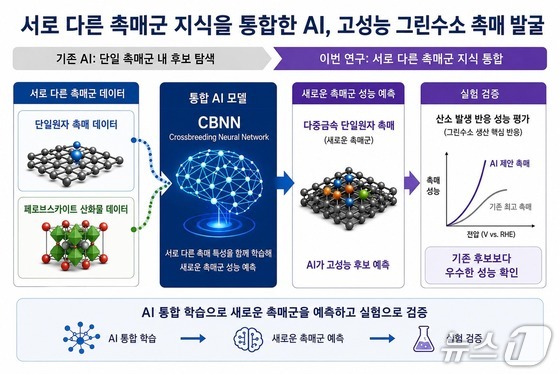
The research team developed a Crossbreeding Neural Network (CBNN) that combines data from single-atom catalysts and perovskite oxide catalysts used in green hydrogen production. They designed it to input information from each catalyst into the AI, enabling them to learn together within a single model.
When comparing and validating this technology against actual synthesis and electrochemical measurements, the performance rankings of 12 catalysts predicted by the AI matched the experimental results precisely. Furthermore, they designed a catalyst that incorporates multiple metal single atoms together, discovering a top-performing material that surpasses both the catalysts included in the existing training data and the newly synthesized ones.
The research team also tracked and analyzed why the AI deemed certain catalysts superior, confirming that having multiple metal single atoms present can lead to greater performance improvements than single metals alone.
The team explained that the most significant distinction of this research is that the AI not only selects candidates within a single material group but also connects knowledge from different material groups to predict new material groups.
Corresponding author Hyeon stated that this technology could expand beyond catalysts to various fields requiring complex material exploration, such as batteries, energy materials, and drug development.
Co-first author Moon Jun-seok emphasized that as AI learns the common language of various material groups, it can propose new design directions beyond the predefined candidate groups, marking an important starting point towards a general-purpose material AI.
The research results were published in the online edition of the international journal Nature Materials.