

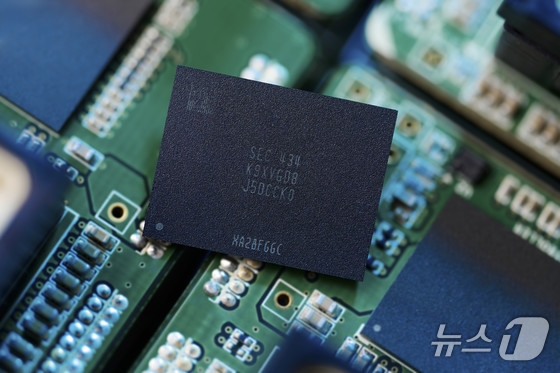
Samsung Electronics Maintains Global NAND Flash Market Leadership as artificial intelligence (AI) Demand Surges
According to a report released on Thursday by market research firm Counterpoint Research, Samsung Electronics has maintained its top position in the global NAND flash market. This comes as the sector experiences a boom driven by expanding AI demand. The global NAND market reached a record-breaking size of approximately 46 billion USD in the first quarter of this year. This figure represents a remarkable 3.5-fold increase year-over-year and nearly 90% growth from the previous quarter.
NAND flash, a non-volatile memory semiconductor that retains data even when powered off, serves as the core storage component in AI data centers and enterprise solid-state drives (SSDs) (eSSDs).
In terms of market share, Samsung Electronics led the pack with 29%, while SK Hynix secured second place with 18%.
Chinese manufacturer YMTC is rapidly gaining ground. Its market share jumped from 8% a year ago to 13% in the first quarter of this year. Boosted by growing local demand and rising prices, YMTC’s revenue skyrocketed by approximately 445% compared to the same period last year.
The NAND market is currently seeing fierce competition for third place among Kioxia, Micron, SanDisk, and YMTC. Industry observers predict that if YMTC secures additional funding through an initial public offering (IPO), it could expand its production capacity, further intensifying the battle for market rankings.
Hwang Min-seong, Research Director at Counterpoint Research, forecasts that if YMTC obtains additional capital through an IPO, it could ramp up production capacity. This move could potentially shake up the competitive landscape among the top three players in the global NAND market.
Notably, enterprise SSDs, primarily used in servers, accounted for 43% of the total NAND market in the first quarter. This share is projected to exceed 60% by year-end. Analysts attribute this structural growth in the NAND market to the rapid proliferation of AI data centers.