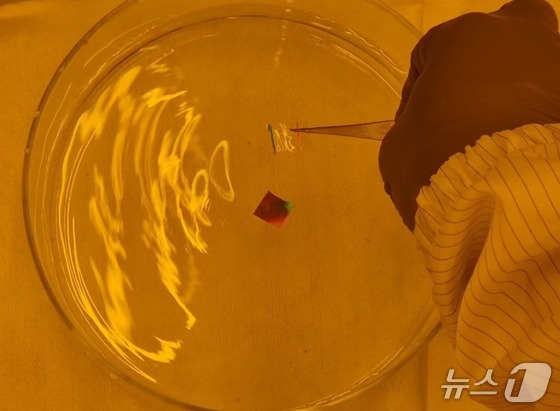
A team of South Korean researchers has developed groundbreaking technology that allows ultra-fine nano circuits to be transferred onto plant leaves, fruits, curved car surfaces, and robot exteriors without causing any damage.
On Monday, the Korea Advanced Institute of Science and Technology (KAIST) announced a collaborative effort between Professor Park In-kyu’s team from the Department of Mechanical Engineering, Dr. Jeong Jun-ho’s team from the Korea Institute of Machinery and Materials (KIMM), and Professor Ahn Jun-sung’s team from Korea University. Together, they created a novel technique called Water-Floating Nano Transfer Printing (WF-nTP), which enables precise transfer of metal thin films floating on water onto various three-dimensional surfaces.
As next-generation nanotechnology rapidly advances in fields such as wearable devices, smart agriculture, and meta optical surface devices, there’s a growing demand for accurately implementing nanostructures on three-dimensional surfaces like curved lenses or plant leaves.
The leading technology addressing this need, known as Nano Transfer Printing (nTP), has limitations. It requires high heat, pressure, strong adhesives, or chemical solvents, making it challenging to apply to delicate biological tissues or complex curved surfaces.
To overcome these constraints, the research team proposed an innovative approach: floating metal circuits on water. They deposited ultra-thin layers of metals like gold (Au), platinum (Pt), palladium (Pd), and nickel (Ni) onto a polymer mold, then selectively removed parts of the mold using plasma.
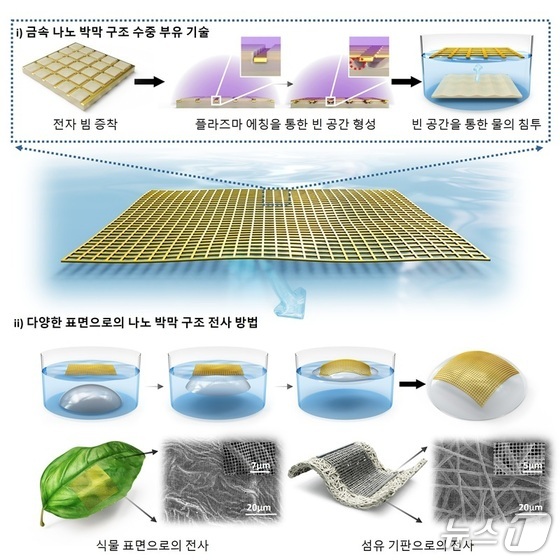
When submerged in water, this structure allowed water to seep through tiny gaps, causing a 20-nanometer (nm) thick metal film to float to the surface while maintaining its original shape.
The team transferred the metal circuit by submerging the target object beneath the floating film and slowly lifting it out. As the water evaporated, capillary forces adhered the circuit to the surface. Once the water fully evaporated, intermolecular forces secured it in place without any adhesive.
Remarkably, the team successfully attached circuits to hydrophobic surfaces like lotus leaves, which typically repel water. They achieved this by adding a small amount of ethanol to the water, reducing surface tension and overcoming existing technological limitations.
This breakthrough technology holds immense potential for various applications, as it can preserve nano patterns while being applied to diverse surfaces.
The research team demonstrated its versatility by creating surface-enhanced Raman scattering (SERS) sensors that attach to plant leaves and fruit surfaces. They successfully detected the pesticide component thiram on lemon and orange peels.
Additionally, they transferred a palladium (Pd) mesh onto flexible thermoplastic polyurethane (TPU) fibers, creating a high-performance wearable hydrogen gas sensor.
Professor Park emphasized the significance of this technology, stating that the method surpasses the limitations of existing nano transfer printing by enabling the transfer of nano patterns onto sensitive surfaces like living plant leaves or skin without adhesives or heat. Its applications range from smart agriculture to wearable health monitoring devices, bioelectronic devices, and next-generation robotic electronic skin. It anticipates it will evolve into a key platform technology for wearable sensors and bioelectronics.

Kang Byeong-ho, a doctoral student from KAIST’s Department of Mechanical Engineering, served as the lead author of this groundbreaking research, which has been published online in the prestigious international journal Nature Communications.
This study was supported by the Korean Research Foundation (NRF) Mid-Career Researcher Support Program and the Korea Institute of Industrial Technology (KEIT) Alchemist Project.