The 2026 National Land Transportation Technology Exhibition kicked off on Wednesday at the Convention & Exhibition Center (COEX) in Seoul, showcasing cutting-edge transportation innovations. Visitors were captivated by a wide array of exhibits, from next-generation high-speed trains capable of reaching 370 km/h (about 230 mph) to Korea Train Express (KTX) driving simulators and rebar tying robots, offering hands-on experiences with future transportation technologies.
Next-Generation EMU-370 High-Speed Train and KTX Simulator on Display
Hyundai Rotem’s booth was a hub of futuristic rail technology, featuring an impressive lineup of displays.
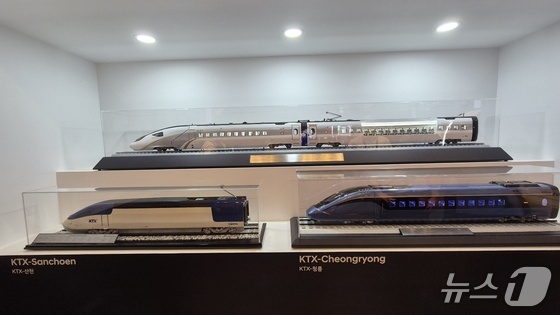
The spotlight was on the EMU-370 model, a next-generation high-speed train designed to operate at 370 km/h 9about 230 mph), exhibited alongside the currently operational KTX Cheongryong (EMU-320).
A Hyundai Rotem spokesperson explained that they’re developing future high-speed trains, focusing on the EMU-320 and the in-development EMU-370, to meet the demand for replacing aging KTX trains. The EMU-370 boasts a 10% reduction in air resistance compared to its predecessor, enhancing energy efficiency, and achieves a 2-decibel reduction in cabin noise.
Korail’s exhibit featured a wheelchair lift designed to assist passengers with disabilities in boarding and alighting from trains.
This innovative equipment halves the slope of existing lifts and incorporates a fixed platform, enabling faster and safer passenger transitions.
A Korail representative stated that they’re currently piloting this system at Seoul Station and plan to refine the product based on the findings.
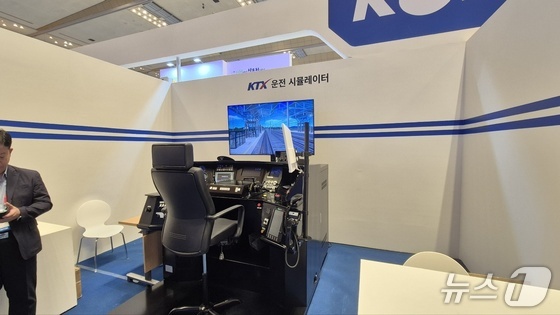
The Korail booth also showcased a KTX driving simulator and a model of a rescue robot designed for emergencies in deep underground platforms.
The Korea Railroad Corporation highlighted its Korean Train Control System (KTCS-2) with a centrally placed operational model.
KTCS-2, a product of national research and development (R&D) efforts, was successfully commercialized after pilot testing on the KTX Iksan-Yeosu Expo line.
The Korea Transportation Safety Authority (TS) demonstrated core technologies for electric vehicle lifecycle safety management using actual electric cars.
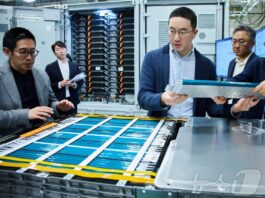
Their display allowed visitors to examine electric vehicle battery structures and showcased advancements in evaluation technologies, including the Korean Green NCAP, which comprehensively assesses electric vehicle (EV) safety systems, fuel efficiency, greenhouse gas emissions, and lifecycle carbon footprint.
Smart Construction Technologies Steal Show With Robots and Drones
The Smart Construction Alliance, a collaborative effort of private companies, government agencies, academic institutions, and public organizations, presented an array of cutting-edge construction technologies.
Hyundai Engineering & Construction impressed with its ground-controlled tower crane technology, underwater drones, and indoor drones.
The company touted its ground-controlled tower crane as a game-changer, allowing operators to manage cranes remotely without entering high-risk areas, while real-time monitoring of the working radius enhances both safety and efficiency.
GS Engineering & Construction unveiled an automated rebar tying robot, leveraging autonomous driving and artificial intelligence (AI) vision technology.
A GS representative revealed that they’re on track to complete R&D by March next year, followed by field demonstrations before full deployment.
The exhibition also featured construction site material transport robots from Samsung C&T and Hyundai Engineering & Construction, welding collaborative robots by POSCO E&C, and Daewoo Engineering & Construction’s innovative ribbed precast floor panel manufacturing technology.
In his opening remarks, Minister of Land, Infrastructure, and Transport Kim Yoon-deok encouraged public engagement, saying that it hopes many citizens will visit to experience these advanced technologies and glimpse the future of infrastructure firsthand.
Co-hosted by the Ministry of Land, Infrastructure, and Transport and the Korea Agency for Infrastructure Technology Advancement, this landmark event brings together 81 organizations across five themed zones: mobility, smart construction, AI cities, aerospace, and innovative enterprises.