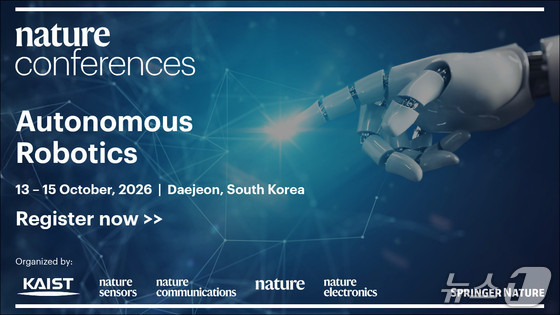
Artificial intelligence (AI) has been at the forefront of digital innovation, but autonomous robotics is now emerging as the key technology that’s bringing this innovation into the physical world. In light of this trend, a groundbreaking global academic event exploring the future of autonomous robots is set to take place at the Korea Advanced Institute of Science and Technology (KAIST).
KAIST, in partnership with the prestigious scientific journal Nature, will host the 2026 Nature Conference: Autonomous Robotics from October 13 to 15 at its main campus in Daejeon.
This marks a significant milestone as it’s the first time Nature has organized a conference solely dedicated to robotics. Previously, Nature has collaborated with world-renowned institutions like Princeton University and Tsinghua University to host over 50 academic events on topics such as artificial intelligence (AI), bioengineering, and energy.
KAIST has been a pioneer in advancing robotics in South Korea, developing the country’s first robotic arm KAISEM, the early intelligent service robot ‘Ami’, and the humanoid robot ‘Hubo’, which has become a symbol of South Korea’s robotics prowess. This conference will serve as a global forum for researchers to discuss the future of autonomous robotics, building on KAIST’s extensive research capabilities.
The conference will feature a star-studded lineup of robotics scholars. Keynote speakers include Sami Haddadin, Vice President of Mohammed Bin Zayed University of Artificial Intelligence and developer of the collaborative robot Franka Emika Panda, known for its human-like arm movements. Dr. Kwon In-soo, head of Korea Institute of Science and Technology’s (KIST) Physical AI Research Center and a leading figure in computer vision and robotic intelligence in South Korea, will also deliver a keynote address.
Other notable speakers include Professor Aude Billard from the Swiss Federal Institute of Technology Lausanne (EPFL), a world-renowned expert in robot learning and control, and Professor Steven H. Collins from Stanford University, a leading authority in wearable robotics.
The event will also feature exhibitions and demonstrations of cutting-edge robotic technologies, as well as academic exchange programs with global researchers and Nature’s editorial team.
KAIST will showcase its latest research achievements, including Professor Kong Kyung-chul’s exoskeleton robot WalkOnSuit, Professor Park Hae-won’s quadrupedal robot Hound, Professor Shim Hyun-chul’s humanoid pilot robot PiBot, and Professor Myung Hyun’s vision-based quadrupedal walking technology DreamWalk. These innovations underscore KAIST’s leadership in autonomous robotics research in South Korea.
Professor Kim Jung, head of KAIST’s Department of Mechanical and Aerospace Engineering, stated that this conference brings together the world’s top researchers to discuss the future of autonomous robotics. It’s an opportunity for KAIST to showcase the innovative technologies and research capabilities on a global stage.
Professor Yu Seung-hyup, head of KAIST’s School of Electrical Engineering, added that robotic intelligence and autonomous operation technologies are poised to revolutionize future industries and society. It hopes this conference will catalyze global research collaborations and accelerate innovations in autonomous robotics.
The conference will be conducted in English and is open to anyone interested in autonomous robotics. Early bird registration is available until July 31, with general registration open until October 6.
The first day of the event will feature robot exhibitions and demonstrations, showcasing advanced autonomous robotic technologies. Attendees will have the opportunity to see KAIST’s flagship projects, including PiBot and DreamWalk, in action.