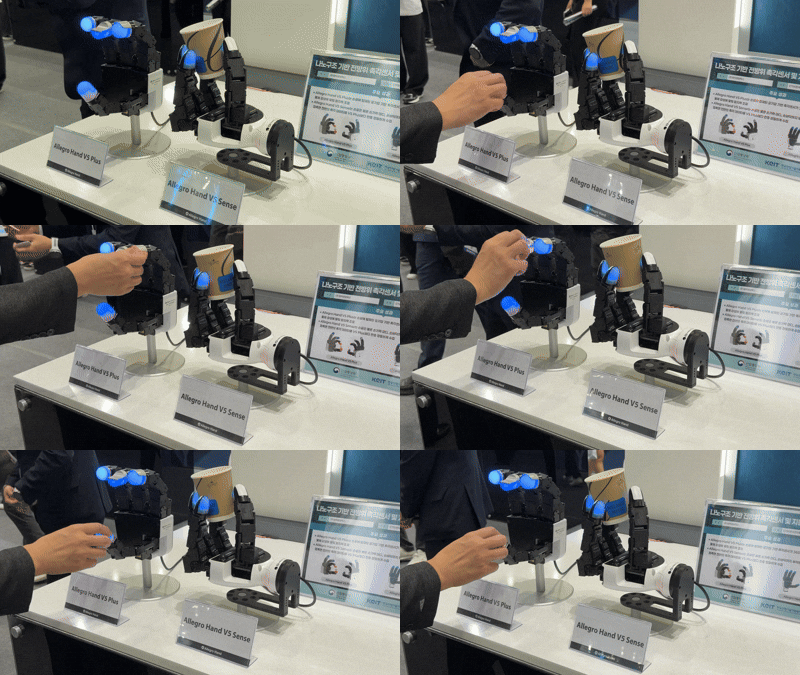
A robotic hand crafted from materials like stainless steel and plastic lacks the innate ability to grip objects with varying pressure or experience sensations. The realm of sensation is reserved for living beings, such as humans.
Yet, before my eyes, a robotic arm moved with surprising dexterity, delicately picking up a soft, easily crumpled paper cup as if it possessed genuine sensory perception.
This robot, leveraging artificial intelligence (AI) and nanotechnology, calculated and reasoned to determine the precise strength needed to grasp the paper cup, then executed the action accordingly.
At the Nano Korea 2026 event, held on Wednesday at the KINTEX Exhibition Center in Goyang, South Korea, an array of robots (physical AI) demonstrated their unique capabilities, showcasing the convergence of AI and nanotechnology.
Unlike conventional exhibition robots programmed to perform predetermined routines like dancing or kung fu, these machines exhibited technologies that push the boundaries of sensory perception. They could actually grip and manipulate objects, making them suitable for real-world industrial applications.
Nano refers to one-billionth of a unit. To put it in perspective, one nanometer (nm) is one-billionth of a meter. Considering that a human hair is roughly 100,000 nanometers thick, we’re dealing with a world invisible to the naked eye.
However, the essence of nanotechnology isn’t merely about miniaturization. It involves engineering materials at the atomic and molecular level to unlock previously nonexistent properties. While AI focuses on learning from data and making judgments, nanotechnology forms the backbone that enhances the performance of semiconductors, sensors, power systems, and cooling devices that support AI operations.
The robotic hand, AI semiconductors, electric vehicle charging components, and data center cooling technologies on display at the event exemplified how this microscopic world has successfully transitioned into practical industrial applications.
From Nano to Industry
As I entered the exhibition hall, I was surrounded by equipment showcasing wide-ranging applications of nanotechnology, including AI semiconductors, robotic tactile sensors, electric vehicle (EV) charging stations, data center cooling systems, and semiconductor post-processing equipment.
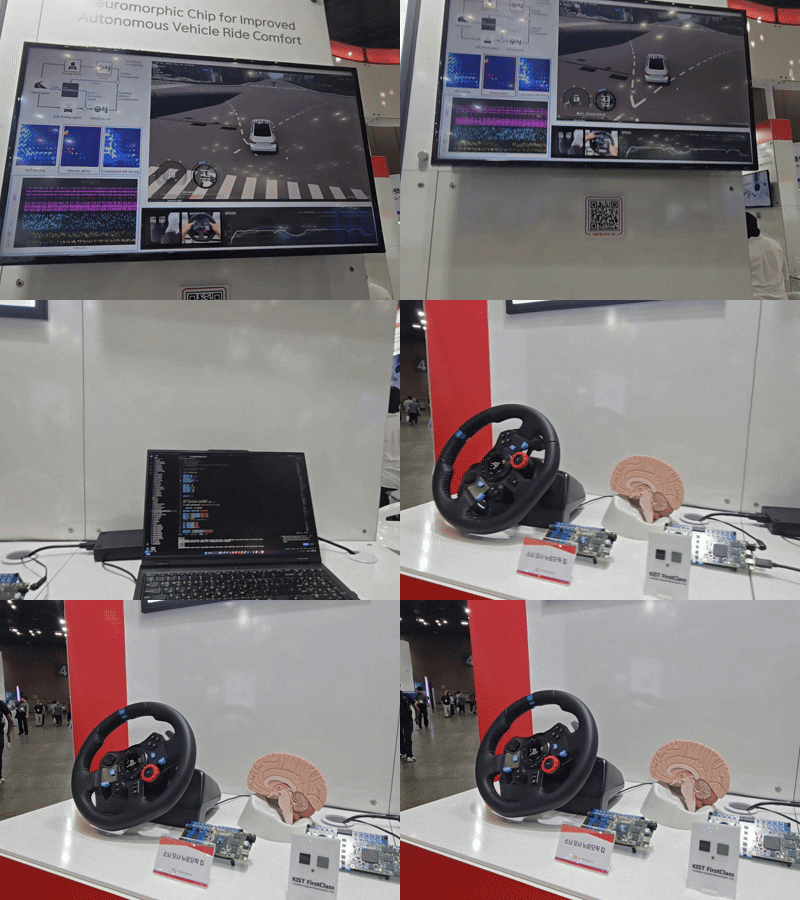
Research on neuromorphic semiconductors, which could potentially expand into physical AI, particularly caught my attention. A research team from the Korea Institute of Science and Technology (KIST) unveiled a neuromorphic chip mimicking the structure of the human cerebellum. This semiconductor is designed to replicate the structure and function of the human brain.
A KIST representative explained that the cerebellum learns motor skills through repeated experiences, like riding a bike, and creates fluid movements. By applying this biomimetic chip to autonomous driving, it can develop self-driving systems that adapt to individual driving styles.
He added that beyond driving, this technology has the potential to expand into various fields of physical AI, depending on how humans train it.
Samsung Electronics’ exhibition centered around AI, showcasing memory, image sensors, and storage technologies in sections dedicated to AI data centers, on-device AI, and physical AI. Samsung Electronics Master Yoon Seok-ho described the evolution of AI beyond data centers to execution on personal devices, highlighting the trend of physical AI where vehicles and robots can independently recognize and assess situations.
LG Electronics’ booth featured AI-based material analysis, electric vehicle charging, and data center cooling technologies. Seong Dae-yong, head of LG Electronics’ Advanced Elements Technology Research Institute, explained that their AI can detect minute contaminants with 95% accuracy and analyze micro light-emitting diode (LED) assembly defects in seconds – a task that previously took humans about ten hours.
This groundbreaking technology, which began at a scale of one-hundred-thousandth of a hair’s thickness, has now emerged as a foundational industrial technology, powering AI semiconductors, robots, electric vehicles, and data centers.