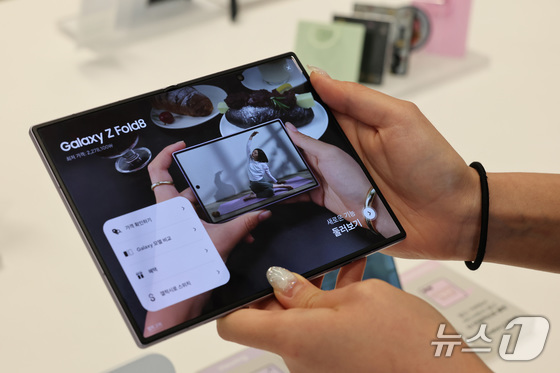
Samsung Electronics is facing increasing competition in the global market for its 4:3 aspect ratio book-type wide foldable phones. Apple plans to include a wide fold model in its first foldable phone set to launch this fall, while Chinese company Xiaomi has also announced plans to release a book-type foldable phone in the second half of this year.
This surge in competition comes as Samsung’s Galaxy Z Fold 8 series has broken pre-sale records, indicating strong market interest. Consumers are overwhelmingly favoring the new Fold 8 design over the traditional Ultra model, confirming demand for book-type foldables.
Industry sources reported on Wednesday that Xiaomi recently held a product launch event, unveiling its Xiaomi 18 Fold. The device is equipped with the company’s new 3-nanometer (nm) mobile processor, the Xring O3, and is set to hit the market in September.
The Xiaomi 18 Fold features a wide foldable design similar to a passport, mirroring Samsung’s recently unveiled Galaxy Z Fold 8.
Departing from its previous naming convention, Xiaomi opted for Xiaomi 18 Fold instead of Xiaomi Mix Fold 5, seemingly taking a page from Apple’s iPhone numbering system.
The Xiaomi 18 Fold is expected to boast a 7.5 to 7.6-inch foldable display, the Xring O3 processor, a 200-megapixel main camera, a side-mounted fingerprint sensor, and a 6000mAh battery. The device is also likely to feature LPDDR6 random access memory (RAM), as the new processor supports this industry-first mobile memory standard.
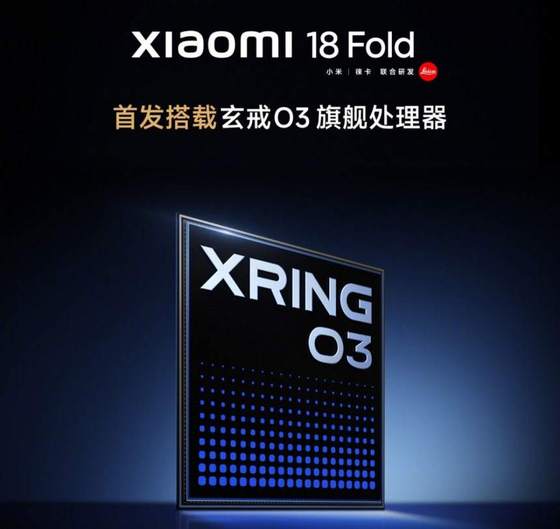
Xiaomi touts the processor as the foldable phone’s key strength. The company claims that the Xring O3 has set a new record on the AnTuTu benchmark, becoming the first mobile processor to surpass 5.22 million points. In the Geekbench 6.5 test, it scored 3945 in single-core and 15,221 in multi-core performance, outperforming the Snapdragon 8 Gen 5 used in the Galaxy Fold 8.
While Xiaomi has previously limited its foldable phone sales to China, the high performance of its new processor may prompt the company to consider international launches, depending on domestic market response.
Apple is also expected to join the foldable phone market, with its first offering, tentatively named iPhone Ultra, anticipated to debut this September.
The iPhone Ultra is rumored to feature a 7.8-inch foldable display when opened, along with a dual-camera setup comprising main and ultra-wide lenses.
Leaked mock-ups suggest the device will be approximately 4.8mm thick when unfolded. However, achieving this slim profile may come at the cost of certain features. The device is expected to use Touch ID instead of Face ID, with a revised physical button layout. It’s also likely to support only wired charging.
Despite these potential limitations, the iPhone Ultra is projected to be priced between 2,000 USD and 2,500 USD. For comparison, Samsung’s Galaxy Z Fold 8 starts at 2.278 million KRW (about 1,645 USD) in South Korea.
The emergence of these competitors is expected to expand the market while increasing pressure on Samsung.
While both the Xiaomi 18 Fold and iPhone Ultra are likely to launch exclusively in their respective domestic markets initially, the significant market share of China and the U.S. in the global foldable phone market could lead to broader availability.
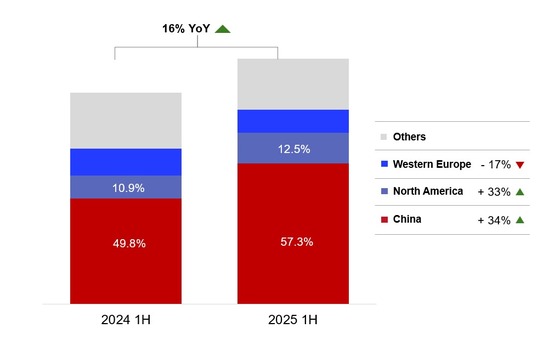
According to Counterpoint Research, China (57.3%) and North America (12.5%) accounted for 80% of the global foldable phone market in the first half of last year.
Market research firm Omdia projects that annual shipments of foldable phones will double compared to the previous year, driven by the introduction of wide foldable form factors.
Omdia’s senior researcher, Jaker Lee, noted that Huawei introduced the first wide foldable phone, the Pura X Max, in May, followed by Samsung’s Galaxy Z Fold 8 in August. He expects other major companies to release similar products in the coming months, sparking a new wave of growth in the foldable phone category.