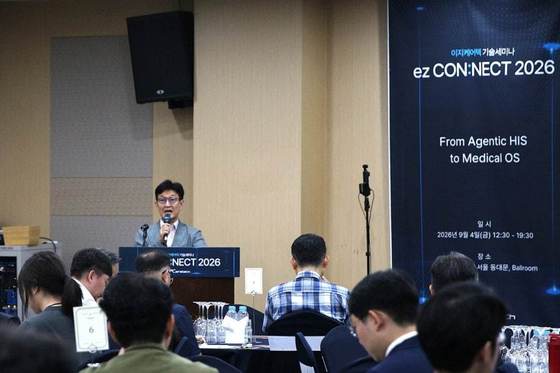
ezCaretech, a company specializing in hospital information systems (HIS), is accelerating its transition from traditional HIS implementation projects to a “Medical AI OS” company that connects medical artificial intelligence (AI), cloud services and data. The company’s strategy is to build a platform connecting medical institutions and AI companies, creating an environment where hospitals can easily use a range of AI solutions. According to industry sources on Sept. 7, ezCaretech is a medical IT company established in 2001 after being spun off from Seoul National University Hospital’s information technology division. It has supplied its build-based HIS, BESTCare, to large hospitals and provided the cloud-based ezEDGE HIS to small and midsize hospitals. The company has recently expanded into platform services that connect medical AI and cloud services to existing HIS systems. The core of the Medical AI OS proposed by the company is not only its own technology but also the integration of external medical AI solutions with HIS systems. It currently has 51 proprietary smart solutions and 50 externally integrated solutions, including 32 AI solutions. The structure connects solutions from outside companies such as Vuno, Lunit and Heuron to hospital systems, allowing medical professionals to use them without having to go through separate, complex integration processes. The platform business is also showing results. Platform revenue reached $2.47 million in the first quarter of this year, more than double the $1.13 million recorded in the same period last year. The platform business’s share of total revenue has also grown from 8% in 2023 to around 18% to 20% recently. ezCaretech aims to raise that share to more than 50% by 2030.

ezCaretech is also expanding AI functions that support medical professionals’ work. The company is incorporating into its HIS systems functions including voice-based patient searches and automated medical-record drafting, medical-record summarization using optical character recognition (OCR) and AI, analysis of patients’ medical histories, and AI-based diagnostic and treatment-plan recommendations. It has also established an AI research and development environment called “AI Forge,” a GPU-based research environment called “ezAI Studio,” and “ezSpace,” which connects medical records and test results between hospitals. The company is also positioning its overseas business as another growth driver alongside its platform business. Overseas revenue increased from $3.47 million in 2024 to $6.53 million last year. The company has set a goal of more than doubling overseas revenue this year from last year’s level. In particular, in Saudi Arabia, the company has expanded beyond its traditional focus on public medical institutions into the private market by recently signing a next-generation HIS implementation contract worth more than $6.67 million with CareMed, a private medical group. The project covers four hospitals and two clinics with about 1,300 beds. ezCaretech has also secured additional business opportunities in Saudi Arabia. It has identified about 10 additional sales opportunities locally and plans to pursue two to three of them within the year. The company also plans to expand business opportunities into Southeast Asia and Africa. The reason ezCaretech is focusing on its platform business is that, unlike its traditional HIS business centered on implementation projects for individual hospitals, connecting various medical AI and digital health services to a single platform can generate recurring revenue. The company has set “All-Connected Medical OS,” which connects hospitals, medical professionals, AI companies and patients within a single ecosystem, as its ultimate goal.
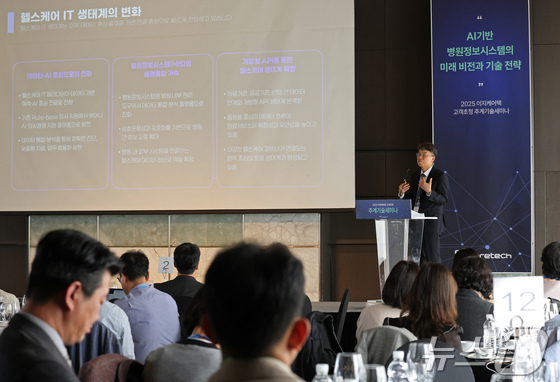
Lee Ji-won, an executive vice president at ezCaretech, emphasized that “we need to build a cloud-based common platform and ecosystem that allows any hospital to easily select and use AI” at the second K-Healthcare Medical Device Promotion Forum, held recently at the National Assembly Members’ Office Building under the theme “Strategies for Expanding Medical AI to Address Gaps in Regional and Essential Healthcare in the Era of Integrated Care.” In particular, Lee proposed a “selective standardization” strategy in which data critical to patient safety and information exchange between medical institutions, including medications, tests, allergies, diagnoses and surgeries, are standardized, while free-text and unstructured data are handled using AI’s ability to understand context. Lee also emphasized that AI should be used as a tool to reduce the workload of medical professionals rather than as a means of replacing them. “The goal of AI is not to replace medical professionals, but to free up their time and give it back to patients,” Lee said. Ultimately, ezCaretech’s strategy is to move beyond simply adding AI functions to existing HIS systems and shift the center of its business toward a platform that allows various AI and medical services to operate within hospital systems. Through this strategy, the company plans to target not only the AI transformation of domestic medical institutions but also demand for digital transformation in overseas healthcare markets, including the Middle East.