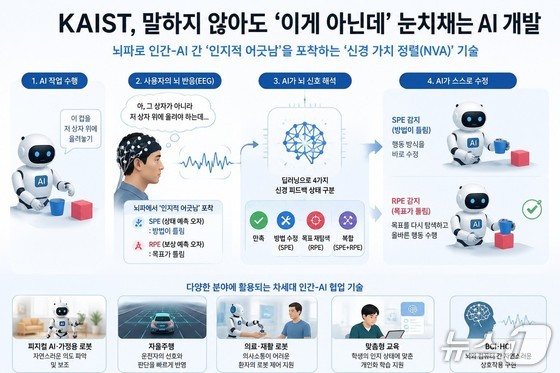
Korea Advanced Institute of Science and Technology (KAIST) announced on Thursday that a research team led by Professor Lee Sang-wan from the Center for Neuroscience and Artificial Intelligence (AI) Convergence has developed a groundbreaking brain-computer interface (BCI) technology called Neural Value Alignment (NVA). This innovative system enables AI to adapt in real-time to human goals using brainwave data, achieved through international collaboration with Microsoft Research Asia.
Traditionally, AI has relied on external cues like speech, actions, and gestures to infer human intentions. However, this approach often falls short due to the inherent ambiguity between goals and behaviors. When AI misinterprets human intent, users are forced to issue new commands or adjust their actions.
To tackle this challenge, the research team focused on unconscious prediction errors that occur in the brain when people encounter unexpected situations.
The team identified two distinct types of responses: Reward Prediction Error (RPE), which occurs when AI misunderstands a person’s ultimate goal, and State Prediction Error (SPE), which arises when the goal is correct but the execution differs from expectations.
By measuring real-time electroencephalogram (EEG) data from individuals observing AI in action, the team confirmed that the brain emits different signals for goal misinterpretation versus incorrect execution. They also uncovered a unique brainwave pattern that emerges when both types of errors occur simultaneously.
Leveraging deep learning, the researchers developed a technique to interpret how individuals perceive AI actions based solely on brainwaves. They then proposed a Neural Value Alignment-based Human-AI Synergy algorithm that transmits these decoded brain signals to AI in real-time, allowing it to self-correct its behavior.
When the AI detects an SPE, it concludes that while the desired goal is correct, its method needs adjustment. In contrast, an RPE prompts the AI to reassess what the person truly wants, indicating a fundamental misunderstanding of the goal.
Simulations demonstrated that this AI adapts more quickly to changes in human intentions compared to existing methods, even in uncertain scenarios with sudden goal shifts or missing signals.
As this technology evolves, it could revolutionize how physical AI robots in homes and industries interpret user intentions and adjust their actions. Potential applications include enhancing self-driving cars’ responsiveness to driver judgments, improving medical and rehabilitation robot control, and enabling AI to tailor educational support based on students’ cognitive states.
The research team plans to develop a system that directly integrates brainwave signal decoding with AI systems or real robots, incorporating cognitive safety mechanisms to validate their approach in more realistic, dynamic environments.

Professor Lee, the study’s lead researcher, emphasized the significance of utilizing cognitive signals generated by the brain in AI collaboration. He envisions the technology expanding into various fields where human judgment and AI actions need to be closely integrated.
Miran Lee, a managing director at Microsoft Research, expressed optimism about the collaboration’s potential to yield world-class BCI technology that enhances natural communication and cooperation between humans and AI.
The groundbreaking study, led by KAIST PhD student Seo Heun and co-authored by researchers from Microsoft Research Asia, including Dr. Janssen Wang, Dongchi Han, and Dongxuan Li, has been published online in the prestigious journal IEEE Transactions on Cybernetics.