The medical community is increasingly focused on monitoring blood pressure changes during sleep as the number of sleep apnea patients rapidly rises. Clinicians are now exploring innovative approaches that combine polysomnography with 24-hour ambulatory blood pressure monitoring to assess cardiovascular risks, including nighttime hypertension.
According to the Health Insurance Review and Assessment Service, the number of patients receiving treatment for sleep apnea in South Korea skyrocketed from 45,067 in 2018 to 196,015 in 2025, a staggering 4.3-fold increase.
Sleep apnea, characterized by repeated breathing interruptions during sleep, can trigger hypoxemia and heightened sympathetic nervous system activity. This, in turn, may lead to elevated blood pressure and increased cardiovascular strain. Some patients exhibit abnormal blood pressure patterns, such as sustained nighttime hypertension or non-dipping hypertension, where blood pressure fails to decrease sufficiently at night or even rises.
Experts stress that a single blood pressure measurement in a clinical setting is inadequate for tracking sleep-related changes, underscoring the importance of 24-hour blood pressure assessments that encompass sleep periods.
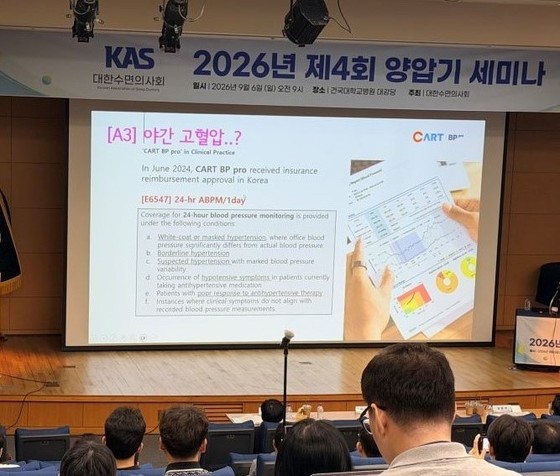
The recent 2026 4th Positive Pressure Device Seminar, hosted by the Korean Sleep Society, delved into the intricate relationship between sleep apnea and cardiovascular disease, emphasizing the critical need for managing nighttime blood pressure.
The seminar highlighted the importance of evaluating sleep apnea patients not only through traditional metrics like the Apnea-Hypopnea Index (AHI) and Oxygen Desaturation Index (ODI) but also by considering blood pressure fluctuations during sleep, including nighttime hypertension.
Presenters shared compelling clinical cases that compared daytime and nighttime blood pressure variations using polysomnography and long-term blood pressure monitoring. They also examined nighttime blood pressure changes before and after positive pressure therapy.
This evolving approach may lead to a more comprehensive assessment of cardiovascular risks alongside respiratory and oxygen saturation levels in sleep apnea treatment.
Sky Labs is exploring the potential applications of its innovative ring-type blood pressure monitor, CART, in managing nighttime blood pressure. CART is designed to measure blood pressure continuously during daily activities and sleep, making it an ideal tool for 24-hour ambulatory blood pressure monitoring.
Since June 2024, health insurance has covered 24-hour ambulatory blood pressure monitoring. When used in conjunction with polysomnography, this method enables a direct comparison of blood pressure changes during sleep with respiratory and oxygen saturation levels. This comprehensive approach aids in the evaluation of nighttime hypertension and abnormal blood pressure patterns in sleep apnea patients.
Sky Labs aims to expand the use of CART beyond traditional hypertension and cardiovascular disease monitoring, targeting areas where blood pressure management during sleep apnea is crucial.
Sky Labs, a cutting-edge medical device company, specializes in collecting and analyzing biometric data through its flagship product, the cuffless blood pressure monitor CART BP Pro. This revolutionary device offers continuous 24-hour blood pressure monitoring during daily activities and sleep. As of June, it has been adopted by over 1,800 hospitals and clinics nationwide, including South Korea’s top five medical institutions.
The company is aggressively expanding its global footprint. Leveraging its CE-MDR certification in Europe and UK Medicines and Healthcare products Regulatory Agency (MHRA) registration, Sky Labs has successfully entered the European market. Strategic collaborations with industry giants like Omron Healthcare and Otsuka Pharmaceutical are driving its expansion into European and Japanese markets. In the first half of this year, Sky Labs reported impressive sales of approximately 5 billion KRW (about 3.73 million USD), with international sales accounting for 2.6 billion KRW (about 1.94 million USD), or 52% of the total revenue.