LG AI Research has unveiled “expert AI” systems for manufacturing, finance and science. The systems could help accelerate the development of autonomous factories, identify new materials and drug candidates, and even predict highly volatile financial markets.
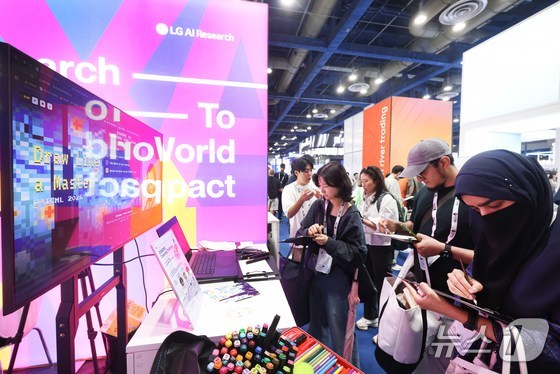
LG AI Research held the “LG AI Talk Concert 2026” on Sept. 14 at the Convergence Hall of LG Sciencepark in Magok, western Seoul, showcasing expert AI systems for manufacturing, finance and science and examples of their applications.
In a keynote speech, Im Woo-hyung, co-president of LG AI Research, said, “To solve problems in industrial settings, we needed AI capable of understanding and making judgments amid countless variables and even the 1% of exceptions, while also being able to demonstrate tangible results.” He added, “That is why LG AI Research has focused on developing expert AI equipped with specialized knowledge in each industrial sector.”
Lee Hong-rak, co-president and chief AI scientist (CSAI) of LG AI Research, held a panel discussion with specially invited guests on “Global AI Trends and Insights on AI in South Korea.”
LG AI Research Unveils Expert AI for Manufacturing, Finance and Science
At the event, leaders overseeing LG AI Research’s research organizations and executives from companies collaborating with the institute introduced examples of AI delivering real-world results across industries.
LG AI Research introduced manufacturing-specific AI foundation models, including EXAONE Tabular, which understands and predicts process conditions and quality information, and EXAONE Omni-Inspect, which can conduct inspections without retraining even when the appearance of processes and products changes.
EXAONE Tabular is a structured-data foundation model that directly analyzes tabular data arranged in rows and columns. It can be used for manufacturing quality control and anomaly detection, customer churn prediction and financial risk analysis. It recently ranked No. 1 overall in the categorical-data prediction category on the global TabArena leaderboard.
Lee Soon-young, head of LG AI Research’s Data Intelligence Lab, and Yoo Jung-sun, who oversees AX at LG Innotek, explained that industry-specific AI foundation models enable fast and accurate predictions using only small amounts of field data in constantly changing industrial environments, while allowing systems to respond flexibly to changing process conditions.
LG AI Research said it is preparing for the evolution toward self-solving AI through a vision inspection agent that autonomously performs data sampling, labeling and model training, opening a new paradigm for manufacturing processes through AX.
The institute also introduced efforts to tackle scientific challenges with AI. Han Se-hee, head of a lab at LG AI Research, and Park Je-seop, head of LG Chem’s R&D AX team, presented a blueprint for an autonomous experimentation system that goes beyond designing materials and predicting synthesis results to conducting actual experiments.
Han, together with Lim Jong-gu, head of GS Caltex’s Advanced Technology Team, also presented a case involving the development of immersion-cooling oil materials for next-generation AI data centers and plans to expand the scope of new-material discovery by the two companies.
LG AI Research said it reviewed 420,000 candidate materials in collaboration with LG Household & Health Care and identified Rhamsydil, a material effective against hair loss, in one day. It is also developing next-generation oral peptide drugs with D&D Pharmatech.
In addition, EXAONE 4.5 has been integrated into an AI system used by South Korea’s Ministry of Food and Drug Safety for new-drug reviews and is expected to help shorten the approval-review process for new drugs.
LG AI Research also unveiled the results of its financial-sector solutions, which are expanding beyond South Korea into global markets.
Lee Hwa-young, head of AI Business Development at LG AI Research, said, “After officially launching EXAONE Business Intelligence, a finance-specific AI solution in which multiple AI agents collaborate to generate everything from data analysis and inference to forecasts and explanations, earlier this year, we have been expanding the business with the London Stock Exchange Group for global markets and Koscom for the domestic market.”
LG AI Research said it would seek to expand into broader markets beyond South Korea, North America, Europe and the Middle East, where it has already secured key customers, and demonstrate further results.
EXAONE Business Intelligence incorporates EXAONE Forecast, an AI foundation model capable of understanding information that changes over time.
100+ Industrial Challenges Solved… 368 Papers Accepted, 1,080 Patents Filed
LG AI Research said that since its establishment in December 2020, it has solved more than 100 industrial challenges, including predicting battery life and capacity, identifying defective products, optimizing production and materials management plans, and discovering drug candidates.
Co-President Im Woo-hyung said, “We were able to solve these challenges because we have built world-class AI research capabilities and technological expertise by presenting 368 papers at leading global AI conferences and filing 1,080 patents in South Korea and overseas.”
The institute then introduced the development of a Robot Foundation Model, which is intended to serve as the brain of robots capable of taking actions in the real world.
LG AI Research said it is conducting research and development into proprietary core algorithms that can prevent accidents caused by robot operation in advance, with “safety” as its top priority.
Co-President Im added, “For the past six years, LG has worked to enable AI to understand industrial problems, and we are now preparing for the stage in which AI can make decisions and take actions on its own.” He added, “Based on robot foundation models, we are moving beyond automating individual robots toward a future of autonomous factories in which the entire factory operates as a single intelligence.”