Researchers have developed an innovative battery electrode technology that significantly enhances lithium-ion mobility and output performance in thicker electrodes designed for high-capacity batteries.
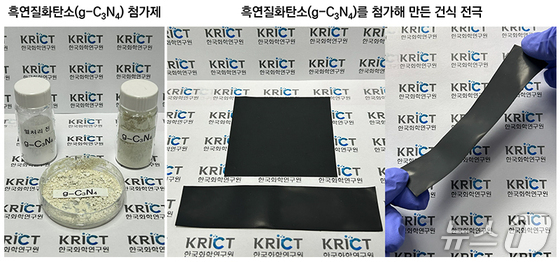
On Tuesday, the Korea Research Institute of Chemical Technology announced a breakthrough in dry film cathode technology. A team led by Drs. Moon San and Seok Jeong-don, in collaboration with researchers from Seoul National University, Yonsei University, and Thermo Fisher Scientific Korea, has pioneered the use of graphitic carbon nitride (g-C₃N₄) as a cathode additive.
Thicker battery electrodes allow for more active material (the electricity-storing substance) while reducing the use of current collectors and separators in the same area. This approach is advantageous for creating high energy density batteries suitable for long-range electric vehicles.
However, as electrodes thicken, a bottleneck effect occurs. Only the top portion of the electrode is efficiently used, while lithium-ion movement slows within the electrode’s interior, making it challenging to fully utilize the stored energy.
The research team employed porous graphitic carbon nitride as a lithium-ion guide within the electrode. The nitrogen on the g-C₃N₄ additive’s surface forms a temporary lithium-nitrogen (Li-N) bond, briefly capturing and releasing passing lithium ions. This process facilitates the transition of lithium ions from the electrolyte coat into the cathode material, similar to placing transfer points within a large building.
Implementation of this technology reduced the activation energy required for lithium-ion movement by 56%, from 49.8 to 22.1 kJ/mol. Additionally, the porous structure enhanced electrolyte wettability, promoting a more uniform distribution of lithium ions throughout the electrode.
A dry electrode approximately 68 micrometers (μm) thick with 0.5% additive demonstrated a 165.9% increase in capacity, reaching 156.2 mAh/g during 3C high-speed discharge. The power density improved by up to 2.85 times. In pouch-type full cells, capacity retention after 600 charge-discharge cycles improved from 72.9% to 81.3%.
The researchers found that simply increasing the additive amount did not necessarily enhance performance. G-C₃N₄’s poor electrical conductivity means excessive addition can increase electrical resistance. Moreover, electrode compression can lead to springback, complicating internal ion pathways over time. The team emphasized the importance of optimizing not only the additive quantity but also its placement within the electrode and the overall pore structure.
Dry electrode technology has the potential to significantly reduce manufacturing costs, energy consumption, and production space by eliminating solvent drying and recovery processes. However, this study did not directly assess mass production yields or manufacturing cost reductions.
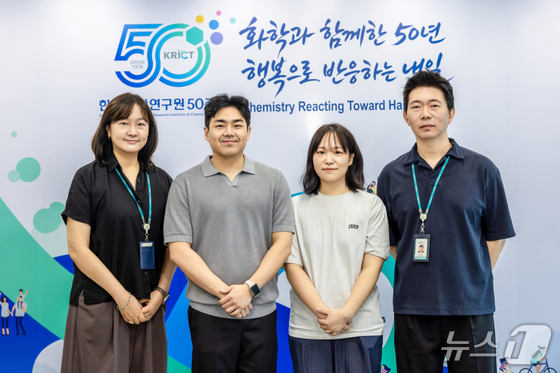
Dr. Moon San, Director of the Secondary Battery Research Center at the Korea Research Institute of Chemical Technology, highlighted the significance of their work: It has achieved simultaneous improvements in electrolyte wettability and ion mobility with just a 0.5% additive. Moreover, it has optimized not only the additive quantity but also its placement and the electrode structure.
This groundbreaking research was featured as the cover article in the August issue of the international journal Exploration.