NVIDIA is pushing the boundaries of physical AI development by combining simulation platforms that mirror real-world physics with advanced robotic hardware and software ecosystems.
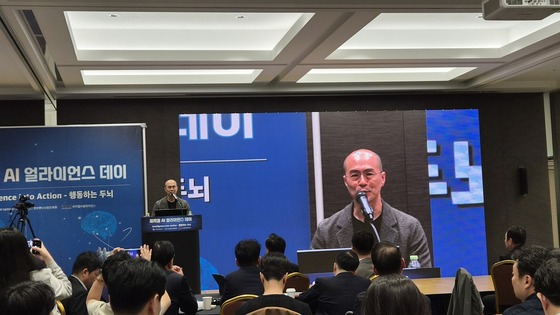
Jung So-young, NVIDIA’s representative, shared these insights during a keynote address at the Physical Artificial Intelligence (AI) Tech Week held on Tuesday at COEX in Seoul’s Gangnam district.
He emphasized that physical AI necessitates the integration of software-based AI with hardware components. Unlike conventional agent AI, physical AI merges AI capabilities with tangible entities in the real world, finding applications across a broad spectrum including humanoid robots, smart factories, and self-driving vehicles.
Jung acknowledged that physical AI still faces significant challenges compared to agent AI, citing numerous constraints due to various complexities.
He highlighted the inherent data scarcity in physical AI development and noted that implementing AI in real-world scenarios involves navigating safety concerns and cost considerations.
Given these challenges, Jung underscored the critical role of simulation in advancing physical AI.
From a robotic perspective, it’s teaching machines to mimic human behavior, Jung explained. Noting further that this involves human experts providing correct responses for various scenarios and tasks, enabling remote training. While this approach yields highly accurate data for the robot, it’s cost-intensive due to the manual nature of the process.
He illustrated this with an example of creating lifelike three-dimensional (3D) environments to simulate how robotic foundation models might operate.
However, Jung cautioned that even the most sophisticated simulations fall short of perfectly replicating real-world conditions.
Recognizing the pivotal role of simulation, Jung continued, NVIDIA is developing robust hardware platforms for effective simulation alongside software platforms for seamless implementation. The flagship offerings include NVIDIA’s Cosmos (World Foundation Model) and Omniverse (3D Simulation Model).
Looking ahead, Jung expressed optimism that as the physical AI market expands and gains prominence, South Korea is well-positioned to play a pivotal role in the physical AI value chain.