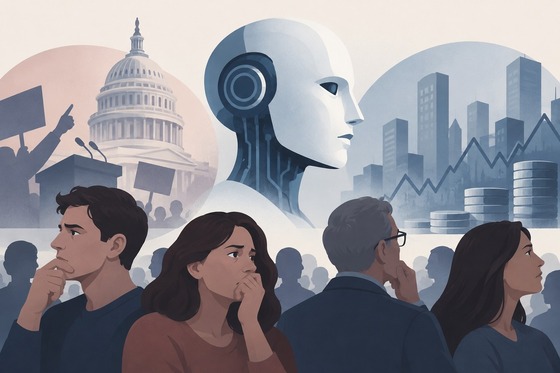
A recent survey reveals that one in two Americans fears artificial intelligence (AI) could negatively impact politics or the economy. This concern extends beyond job displacement, indicating growing anxiety about AI’s potential effects on broader political and economic systems.
The 2026 Survey of American Fears, released on Wednesday by Chapman University, shows that 51.9% of respondents worry AI could harm the political process, ranking third among all survey items. Additionally, 49.7% expressed concern about AI’s potential negative impact on the economy, placing seventh overall.
Chapman University has been tracking various social fears among Americans since 2014. This year’s survey included AI-related concerns for the first time, with fears about its influence on politics and the economy both breaking into the top ten.
While previous AI concerns primarily focused on job loss and automation, this survey highlights growing apprehension about AI’s impact on political decision-making and the overall economic landscape.
Interestingly, the level of concern varied based on individuals’ experiences with AI. Among respondents who use AI at least weekly, 46% feared it could harm the political process. In contrast, 55% of those who never use AI shared this concern, a 9 percentage point difference.
This suggests that frequent AI users tend to be less worried about its political implications. However, the survey alone cannot conclusively determine whether AI experience directly reduces these fears.
Researchers emphasized that societal concerns about AI are expanding beyond traditional issues of automation and job loss, encompassing broader worries about political and economic systems.
The survey also revealed that government corruption remains the top fear among Americans.
Fear of corrupt government officials ranked first at 61.1%, maintaining its position as the highest concern for the eleventh consecutive time.
Following closely, the fear that the U.S. could become embroiled in another world war ranked second at 58%, jumping four spots from sixth place last year.
Other significant concerns included worries about loved ones suffering from serious illnesses (51.8%, ranking fourth) and fears about the death of a loved one and the collapse of the economic and financial system (both at 50.6%, tying for fifth place).