The share of work-related messages from South Korean ChatGPT users requesting visual design or content creation has more than doubled in a year, making it the second-most common work activity after document and writing edits.
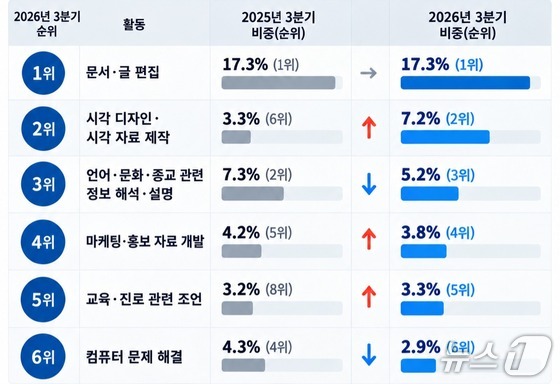
According to South Korean data from OpenAI Signals, released by OpenAI on the 30th, visual design and content creation accounted for 7.2% of work-related messages from personal ChatGPT accounts in the third quarter, up 3.9 percentage points from 3.3% in the same period last year.
The share increased approximately 2.2-fold over the year, pushing the activity from sixth to second place in the ranking of work-related tasks. It also rose steadily throughout this year, increasing from 3.6% in the first quarter to 5.8% in the second quarter and 7.2% in the third.
Document and writing edits accounted for the largest share of work-related messages. The category remained in first place, recording 17.3% in both the third quarter of last year and the third quarter of this year.
By contrast, requests to interpret or explain information related to language, culture and religion, which ranked second last year, fell from 7.3% to 5.2%, dropping to third place. Requests to develop marketing and promotional materials declined from 4.2% to 3.8%, while computer troubleshooting fell from 4.3% to 2.9%.
Requests for education and career advice edged up from 3.2% to 3.3%, rising from eighth to fifth place in the rankings.
The analysis is based on a monthly sample of 1 million messages from personal ChatGPT accounts registered to users aged 18 and older worldwide. Work-related messages were categorized into 165 detailed work activities using the classification system of the Occupational Information Network (O*NET), a U.S. occupational information database.
The findings are available quarterly for approximately 100 countries, covering the period from the first quarter of 2025 through the third quarter of this year. However, the sample size for South Korean users was not disclosed separately.
OpenAI said it used artificial intelligence (AI) to automatically classify messages after removing identifying information, adding that researchers did not personally read individual conversations during the study.
The statistics cover only work-related messages from personal accounts. Messages from business accounts and use of Codex were excluded, as were users who had deleted their accounts or opted out of having their data used to train models.