

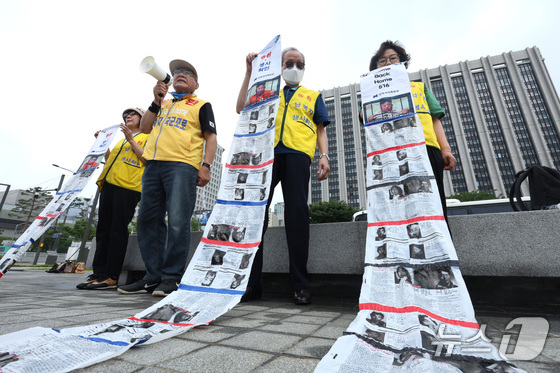
Experts have proposed that resolving North Korea’s civilian abduction issue requires intensifying international public debate, as no single country can address this problem independently.
During an international conference organized by the Korean War Abductees’ Family Union (KWAFU) on September 18 to commemorate the 75th anniversary of the Korean War abductions, Emeritus Professor Je Sung-ho of Chung-Ang University asserted that North Korea’s civilian abductions involve over ten countries, including Japan and Thailand, with the number of victims estimated at around 100,000.
Professor Je emphasized that the first step in raising global awareness is for the international community to condemn North Korea’s abductions and widely communicate that these acts constitute serious crimes against humanity that shock the conscience of mankind.
He suggested that on this psychological and moral foundation, conscientious groups worldwide can mobilize, initiate reform actions, organize, and unite. Furthermore, they can persistently engage with North Korean authorities and relevant international organizations.
Additionally, he pointed out that the South Korean government bears some responsibility for wartime abductions, similar to post-war abductions. It failed to prevent these kidnappings, neglected the issue for an extended period, and allowed human rights violations against victims’ families based on guilt by association, including surveillance, employment restrictions, travel limitations, and torture.
Ri So-ra, director of the International Research Institute for North Korean Repatriation, urged the South Korean government and citizens not to neglect resolving this issue, stating that as it marks 80 years of division and 75 years since the Korean War, it must fulfill the mission and responsibility that history and the times have bestowed upon them.
He argued that if the South Korean government and people had united to swiftly and accurately resolve the issue of civilian abductions during the Korean War, they could have made it clear to North Korea that human rights take precedence and that violations would never be tolerated, thereby upholding global justice and truth.
In the second session, titled, The Issue of Civilian Abductions in North Korea from a Foreign Perspective, Brazilian lawyer Marcos Vinicius referenced methods used to address forced disappearances during Latin American dictatorships. He emphasized that North Korea remains a closed regime where external pressures have limited effects, and we must recognize the unique characteristics of this issue.
He suggested that South Korea’s strategy should balance humanitarian appeals with a firm human rights discourse. The issue of missing persons in Korea is both a domestic concern and a universal humanitarian issue, which can be addressed through cooperation with traditional allies and by strengthening networks within global civil society.
Lee Kyu-chang, a senior researcher at the Korea Institute for National Unification, advocated for international cooperation to resolve wartime abductions. He stated that to halt forced disappearances and clarify responsibilities for wartime abductions, we must persistently urge North Korea to ratify the international convention on preventing forced disappearances through collaboration with the global community.
He also proposed that reforming North Korea’s current criminal justice system requires long-term support for bilateral and multilateral human rights dialogues and technical cooperation to improve laws and institutions.