

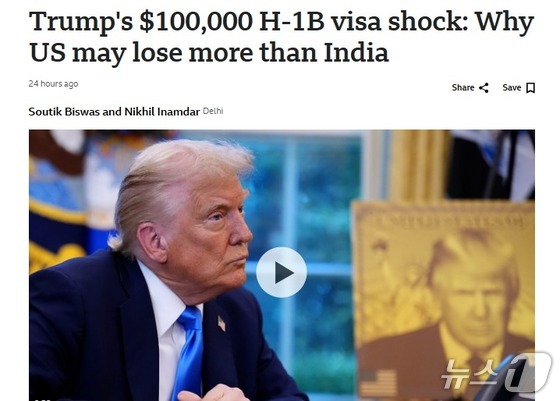
The BBC reported on Tuesday that the Donald Trump administration’s decision to increase H-1B visa fees a hundredfold will initially deal a severe blow to India, but it could ultimately backfire, inflicting significant damage on the U.S.
On September 19, the White House announced plans to raise the H-1B visa fee for foreign tech workers from 1,000 USD to a staggering 100,000 USD.
Immigration experts have unanimously condemned the 100,000 USD fee as exorbitant, noting that the average salary for new H-1B employees in 2023 is 94,000 USD. This creates a scenario where the expense ends up eclipsing the gain.
India is expected to bear the brunt of this measure, as 71% of H-1B visas are issued to Indian nationals.
For many Indians, the H-1B visa has long been seen as a golden ticket to achieving the American Dream.
Indians who have thrived through this visa program have often reinvested in their homeland by purchasing real estate and fueling India’s economic boom.
However, with this astronomical fee increase, such economic windfalls for India are likely to come to an abrupt end.
The BBC predicts that the U.S. will be the next to feel the impact, warning that the consequences will be far-reaching and profound.
Silicon Valley could grind to a halt without Indian talent, given that one-quarter of its workforce is of Indian origin.
The medical field, in particular, is bracing for a significant hit, as over 6% of all doctors in the U.S. are of Indian descent.
In fiscal year 2023, 8,200 Indian doctors received H-1B visas, accounting for 22% of foreign doctors in the country.
Immigration policy analyst Gil Gerra told the BBC that while India might feel the initial shock, the ripple effects will be deeper and more widespread in the U.S.
Indian information technology (IT) giants like Infosys have long been preparing for such a scenario by restructuring their local workforce and shifting delivery systems overseas.
Moreover, Indian firms are likely to pass on the increased costs from soaring fees to American consumers.
As a result, the impact on the U.S. economy and society is expected to be extensive and severe.
Hospitals already grappling with doctor shortages, universities struggling to attract international students, and startups lacking lobbying power will all feel the immediate pinch.
Immigration experts unanimously predict that the visa fee hike will force U.S. companies to radically alter their hiring strategies and offshore a significant portion of their operations.
While the Trump administration claims these measures will protect American jobs, they may ironically accelerate outsourcing and lead to domestic job losses.
David Bier, director of immigration studies at the Cato Institute, warned, according to the BBC, that this move could deal a crippling blow to American innovation and competitiveness.