

The Ministry of Unification, which did not participate in the regular consultations established to coordinate North Korea policies between South Korea and the U.S., announced on Tuesday that they are currently in frequent communication with the U.S. Embassy in Korea. They added that when conditions allow, they can discuss necessary matters with the State Department.
When a ministry official met with reporters that day and was asked how the Ministry of Unification would conduct separate discussions with the U.S. on North Korea policy issues, they provided this response.
Furthermore, when questioned about whether the Ministry of Unification and the Ministry of Foreign Affairs were pursuing different approaches in future North Korea consultations, the official clarified that it’s not about different paths. Instead, they discuss with the U.S. on a departmental and issue-by-issue basis.
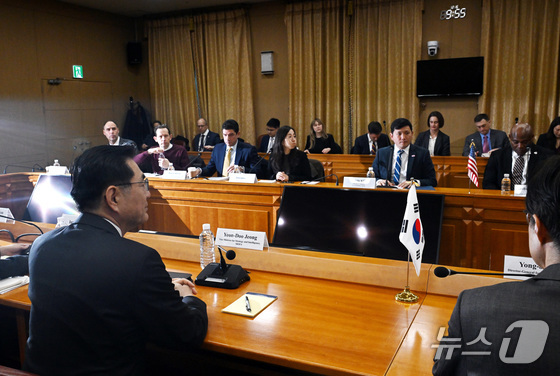
Earlier, the Ministry of Unification decided to abstain from the regular consultations for coordinating North Korea policy that South Korea and the U.S. agreed to conduct regularly starting that day. The ministry explained that this consultation was a follow-up to implement the joint fact sheet containing the agreements from the South Korea-U.S. summit. They stated that discussions on North Korea policy related to inter-Korean dialogue and cooperation would proceed separately with the U.S.
When asked if the Ministry of Unification would exclude the Ministry of Foreign Affairs in future communications with the U.S., the official carefully responded that it means the Ministry of Unification will take the lead, but it doesn’t mean they are excluding the Ministry of Foreign Affairs.
They continued that there are suggestions that the Ministry of Unification and the Ministry of Foreign Affairs are in a power struggle or conflict, but that’s not an accurate view. It has a common goal of establishing peace on the Korean Peninsula, so while its approaches may differ, they ultimately converge to express a unified government position.
The Ministry of Unification appears to have decided not to participate in the regular consultations due to the perception that they mirror the South Korea-U.S. Working Group established in 2018. This working group served as a separate forum for discussing necessary issues to simultaneously advance North Korea denuclearization negotiations and inter-Korean cooperation, with relevant departments participating under the leadership of the Ministry of Foreign Affairs and the State Department.
However, at that time, the U.S. pressured South Korea to slow down the pace of inter-Korean cooperation projects through the working group, arguing that these projects were progressing faster than the denuclearization negotiations.
On that day, the ministry official remarked that opinions on the working group are divided, adding that while there are positive aspects where South Korea and the U.S. communicate closely, it’s also true that this aspect has excessively hindered the progress of inter-Korean cooperation.
The Ministry of Unification reportedly views its prior participation in the separate working group as unusual, and interprets its absence from the regular consultations as a normalization step that considers the division of roles by department.
Meanwhile, South Korea and the U.S. changed the name of the regular consultations held that morning at the Ministry of Foreign Affairs in Seoul from Regular Consultations on North Korea Policy (Coordination Meeting) to Follow-up Consultations on the Joint Fact Sheet from the South Korea-U.S. Summit. This change appears to be aimed at mitigating any perception of discord within the government following the Ministry of Unification’s absence.