

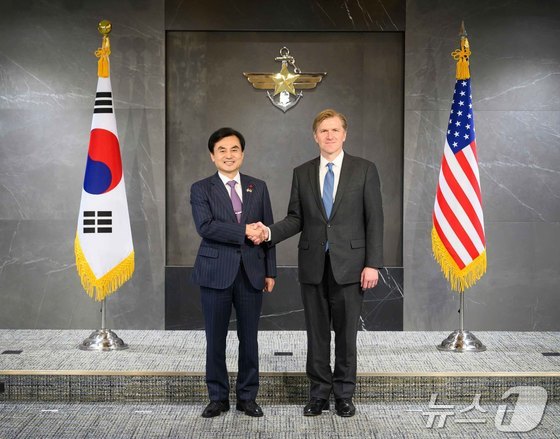
Elbridge Colby, U.S. Deputy Assistant Secretary of Defense for Policy, visited South Korea on Monday to discuss ways to modernize the U.S.-Republic of Korea (ROK) alliance and reiterated the need to counter China.
Colby’s visit to South Korea immediately following the release of the new U.S. National Defense Strategy (NDS) is seen as a deliberate move to send a clear message to both South Korea and China about the need for stronger U.S.-ROK cooperation in countering Beijing’s influence.
During his speech at the Sejong Institute, Colby stated that it must soberly recognize China’s ongoing military modernization, expansion, and increasing military activities beyond this region. This is not criticism for criticism’s sake, but a simple and clear observation, and an undeniable physical reality that it must address seriously.
He emphasized that the Indo-Pacific region is the center of global growth and the pivot of 21st-century geopolitics. Colby added that the future of this region will decisively shape America’s long-term security, prosperity, and freedom. Stability in Asia can only be maintained through a balance of power that prevents any single nation from dominating the region. This message underscores the importance of South Korea’s cooperation in maintaining Asian stability and suggests that failure to successfully counter China militarily could pose a threat to America’s national destiny.
Notably, Colby mentioned plans to establish a strong denial defense line along the First Island Chain (a line connecting Japan’s Kyushu, Okinawa, Taiwan, and the Philippines) to prevent China’s expansion into the Pacific. This statement could be interpreted as a willingness to deploy U.S. forces in South Korea in the event of a Chinese invasion of Taiwan or other contingencies.
NDS Architect’s Visit to South Korea and Japan: Emphasizing U.S.-ROK-Japan Cooperation As Key to Countering China
Colby is the architect of the new U.S. NDS. The Donald Trump administration’s recently released 2026 National Defense Strategy stated that South Korea should bear primary responsibility for deterring North Korea, while the U.S. would provide decisive but limited support.
The U.S. government’s position, as interpreted through the NDS, is to maintain its current extended deterrence against North Korea’s nuclear threats while expecting South Korea to take greater responsibility for conventional threats, such as direct provocations or invasions by North Korean forces. This officially confirms the intention to reduce U.S. Forces Korea’s (USFK) deterrence capabilities against North Korea and redirect them towards countering China.
In this context, the role of USFK is likely to shift from an army-centric structure to one that emphasizes advanced air and naval forces. This change is expected because air and naval forces are more easily deployable to other regions in case of emergencies. Currently, out of the 28,500 USFK personnel, about 18,000 are army troops, but this structure is anticipated to change significantly. In line with this shift, there is speculation that the U.S. may transform USFK bases in Gunsan, Osan, and Pyeongtaek into forward air bases aimed at China.
Colby’s visit to South Korea is interpreted as an effort to highlight these messages, signaling to China that South Korea is on our side while simultaneously warning South Korea not to move closer to China. Colby is scheduled to visit Japan on Tuesday, a country currently in conflict with China over Taiwan. This diplomatic move appears to be a symbolic effort to pressure China by emphasizing that the U.S., South Korea, and Japan are key components of America’s strategy to counter China in the Indo-Pacific region.
Concerns Over Potential Setbacks to the Government’s North Korea Policy, Which Requires China’s Support
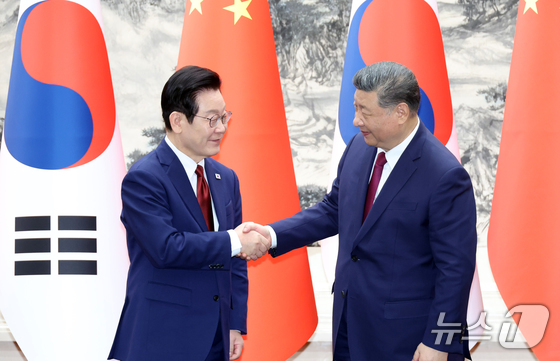
Some experts predict that these changes could negatively impact the government’s North Korea policy, which requires China’s cooperation and support.
The Lee Jae Myung administration plans to fully activate the Korean Peninsula Peace Coexistence Process through cooperation with neighboring countries starting this year. The government has repeatedly emphasized the importance of China’s constructive role in facilitating inter-Korean dialogue.
Following the recent South Korea-China summit, National Security Advisor Wi Sung-lac stated that it confirmed China’s willingness to play a constructive role for peace and stability on the Korean Peninsula. Based on this, the leaders of South Korea and China agreed to continue exploring creative ways to build peace.
However, while China has not outright rejected this approach, it has yet to take an active role as a mediator. President Xi Jinping’s direct statement that patience is needed is interpreted by some as a response to both the North Korea-China relationship and the strengthening U.S.-ROK alliance, which is increasing its efforts to counter China.
Professor Kim Jung of the University of North Korean Studies noted that for China, the strategic shift of U.S. forces in Korea is a highly sensitive issue intertwined with the Taiwan Strait problem. China may use its discomfort with these changes as a reason to avoid readily responding to the government’s requests for cooperation on North Korea issues.
It was reported that Unification Minister Chung Dong-young recently requested President Lee to appoint him as a special envoy for peace on the Korean Peninsula and send him to China. However, it appears that China’s response has been lukewarm. Some experts worry that even if China accepts the special envoy, it may increase diplomatic pressure by demanding advanced positions from the South Korean government on issues such as Taiwan.
Professor Kim advised that the government needs to manage risks by explaining to China that pursuing strategic flexibility for U.S. forces in Korea is an effort to transfer wartime operational control within President Lee’s term, while emphasizing that Korean forces will not be directly involved in changing the status quo in the region in any form.