

A government think tank has concluded that North Korea’s economy likely grew by about 10% cumulatively over the past five years. This assessment suggests that the North Korean economy, which had been in decline, is now showing signs of recovery, particularly in the industrial and agricultural sectors, as it moves towards normalization.
However, this year’s growth trajectory could be influenced by factors such as inflation due to soaring exchange rates and the extent of trade between North Korea and China.
According to the North Korea Economic Review January Issue published by the Korea Development Institute (KDI) on Tuesday, assuming a 3% economic growth rate for North Korea last year, the country’s economy is estimated to have grown by approximately 10% cumulatively during the 2021-2025 national economic development five-year plan period.
This figure stands in stark contrast to the 11.4% contraction in North Korea’s economy in 2020 compared to 2016.
While prolonged sanctions and COVID-19 border closures had previously led to a cumulative decline in industrial production and overall income conditions, the past five years have seen economic indicators improve compared to the starting point, despite operating under the same sanctions environment.
The recovery has been primarily driven by the industrial and agricultural sectors. Through its 2021-2025 five-year plan, North Korea has focused on regime stability and the maintenance and enhancement of existing industries.
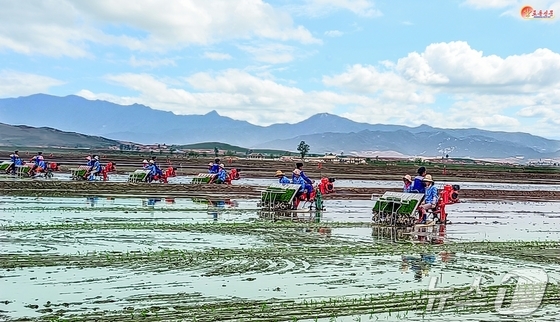
Last year, North Korea’s grain production reached 4.9 million tons, an increase of 120,000 tons from the previous year’s 4.78 million tons. This marks a significant increase of about 500,000 tons compared to the 4.4 million tons produced in 2020, before the five-year plan began.
In the industrial sector, rolled steel production increased by 46% in 2024 compared to 2023, while non-ferrous metal production expanded by 40%.
KDI Senior Research Fellow Lee Jong-kyu noted that the increase in rolled steel production, which is used in construction, power generation equipment, and defense industries, indicates very active growth in these related sectors. This suggests that North Korea’s stated priority on developing the metals and chemical sectors within the five-year plan is having a tangible impact.
Consequently, national budget revenue has also shown an upward trend. While the average annual increase in national budget revenue during the border closure period of 2021-2023 was 1.4%, it rebounded to 4.3% in 2024.
KDI analysts warn that soaring exchange rates and inflation could significantly impact this year’s economic growth rate.
In January 2024, the exchange rate of the dollar to the KPW skyrocketed from 8,375 KPW (about 9.3 USD) to 37,700 KPW (about 41.9 USD) in December of last year, more than a fourfold increase. The average monthly exchange rate last year rose by over 120% compared to the previous year.
The research fellow explained that recently, both the USD and the CNY have sharply depreciated against the KPW, leading to rapid increases in the prices of essential goods like rice and fuel. This situation likely results from a combination of short-term supply shocks, stricter foreign exchange controls, spreading inflation expectations, and currency depreciation. If this instability spreads across the market, it could act as a significant constraint on growth.
Additionally, the continuation of centralized economic management by the cabinet and the potential expansion of trade with China have been identified as other variables that could impact economic performance.
While centralized economic management can maintain policy execution and resource mobilization capabilities in the short term, it may significantly restrict market functions, potentially limiting long-term growth potential. Increased trade with China could exacerbate exchange rate instability due to rising foreign currency demand.
The research fellow concluded that North Korea’s economy is moving into a recovery phase, but this is largely a result of focusing on managing outcomes within areas the state can control. The growth rate in the coming year will depend on how much of last year’s achievements can be conveyed to the private sector and whether improvements in exchange rate and price stability, as well as foreign trade structures, can expand the scope of economic impact.