

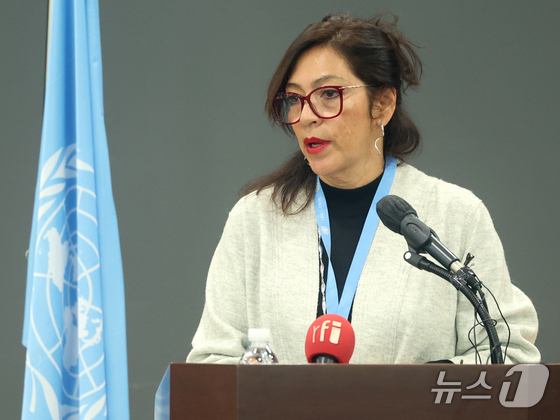
Elizabeth Salmon, the UN Special Rapporteur on North Korean Human Rights, declared on Friday that Ukraine has a legal obligation not to repatriate the two North Korean soldiers currently in its custody.
During a press conference in Seoul, Salmon said that under the Third Geneva Convention, the two individuals qualify as prisoners of war and therefore must be protected from violence, threats, humiliation, and public curiosity at all times.
She criticized the public circulation of photos and videos featuring the North Korean soldiers, stating that this represents a complete failure to provide the basic protections they are entitled to.
Salmon reiterated that there are credible grounds to believe that continued exposure would put not only the soldiers but also their families at risk of retaliation. Therefore, Ukraine has a legal duty not to return them. She expressed hope that Ukraine would make a prudent decision in line with international law, such as transferring them to a third country or granting them asylum.
The two North Korean soldiers, captured by Ukrainian forces in Russia’s Kursk region last January, remain detained in a Ukrainian prison camp. They have expressed their desire to go to South Korea in interviews. The South Korean government, adhering to its constitutional principle that North Korean residents are also citizens of South Korea, has stated that it recognizes their right to return on a personal basis. Unofficial discussions with Ukraine are reportedly ongoing.
Commenting on North Korea’s human rights situation, Salmon said that over the past decade, overall human rights conditions had not improved and that despite minor advancements in some isolated areas, many aspects had deteriorated.
She specifically noted that the surveillance system had been bolstered with cutting-edge CCTV equipped with facial recognition technology. At the same time, freedom of movement remained severely restricted, adding that leaving North Korea is virtually impossible.
On international accountability for North Korean human rights violations, Salmon said the global community faced significant hurdles, pointing to ongoing worldwide conflicts and certain actors that are threatening the very concept of multilateralism. She added that while the Security Council is aware of the issue, there have been no tangible results at present.
Salmon emphasized that human rights issues should not be separated from diplomatic and security discussions, saying human rights must be a central and forceful component in any negotiations with North Korea and that without human rights guarantees, sustainable and lasting peace is unattainable.
She added that human rights should be viewed not as a problem but as an opportunity to foster engagement. She urged expanding dialogue channels with North Korea to address human rights concerns.
She outlined practical discussion topics, suggesting that the repatriation of missing persons, return of remains, establishment of regular independent monitoring mechanisms, improved treatment of detainees, ensuring vulnerable groups’ access to food and healthcare, redeployment of UN investigative teams, and reporting on the implementation of universal periodic review recommendations could all be integral to the reintegration process.