

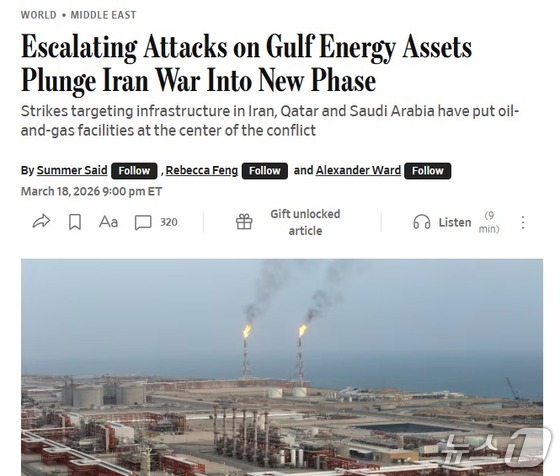
The Wall Street Journal (WSJ) reported on Wednesday that the U.S. has escalated its involvement in the Middle East conflict by targeting oil infrastructure it had previously avoided, signaling a more complex and volatile phase in the region.
The situation intensified after Israel struck Iran’s massive gas field, prompting Iran to retaliate by attacking Qatar’s largest gas field, a critical asset for the world’s leading exporter of liquefied natural gas (LNG).
While Iran and Israel have occasionally targeted each other’s energy assets in the past, these recent strikes on world-class energy infrastructure facilities represent a significant escalation in the conflict.
The impact was immediately felt in global markets, with Brent crude futures surging over 8% to 111 USD per barrel, while natural gas prices in Europe jumped 6%.
This marks a stark departure from previous U.S. strategy, which had carefully avoided Iranian oil and LNG infrastructure to minimize disruptions to the global energy market.
In a surprising move, the U.S. tacitly approved Israel’s strike on Iran’s gas field, effectively outsourcing the attack.
The WSJ analysis suggests that this shift in U.S. policy aims to exert maximum pressure on Iran, which has been blockading the strategically crucial Strait of Hormuz.
Senior U.S. officials, speaking to the WSJ, revealed that President Donald Trump authorized this airstrike to compel Iran to lift its blockade of the Strait of Hormuz.
The WSJ concludes that this development signals a new, more dangerous phase in the Middle Eastern conflict, with potentially severe repercussions for international energy markets.