

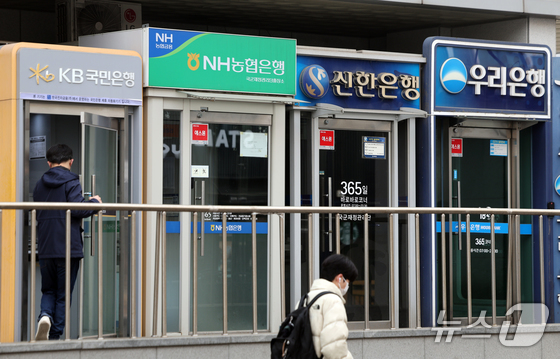
Domestic banks in South Korea achieved record-breaking profits last year, with net income surpassing 24 trillion KRW (about 16 billion USD). However, this year brings heightened uncertainty due to geopolitical risks from the Middle East, U.S. trade policies, and increased volatility in interest rates and exchange rates, raising concerns about potential credit losses.
The Financial Supervisory Service reported on Thursday that domestic banks’ net profit reached 24.1 trillion KRW (about 16.1 billion USD) in the previous year, an 8.2% increase (1.8 trillion KRW or about 1.2 billion USD) from the 22.2 trillion KRW (about 14.8 billion USD) recorded in the prior year.
Commercial banks saw net profits of 16.2 trillion KRW (about 10.8 billion USD), with major banks increasing their earnings by 1.3 trillion KRW (about 869 million USD) year-over-year, while internet banks added 100 billion KRW (about 66.8 million USD). Regional banks, however, experienced a slight decline of 30 billion KRW (about 20 million USD).
Special banks reported net profits of 7.8 trillion KRW (about 5.2 billion USD), up 400 billion KRW (about 267 million USD) from the previous year’s 7.4 trillion KRW (about 4.9 billion USD).
The return on assets (ROA) for domestic banks remained stable at 0.59%, comparable to the previous year’s 0.58%. The return on equity (ROE) rose to 7.93%, a 0.17 percentage point increase from 7.76% the year before.
Interest income for domestic banks grew to 60.4 trillion KRW (about 40.3 billion USD), a 1.8% increase (1.1 trillion KRW or about 735 million USD) from the previous year’s 59.3 trillion KRW (about 39.6 billion USD).
Despite a decrease in net interest margin (NIM) from 1.57% in 2024 to 1.51% in 2025, interest income rose due to a 4.6% year-over-year increase in interest-earning assets, which reached 3,442 trillion KRW (about 2.3 billion USD).
Non-interest income surged to 7.6 trillion KRW (about 5 billion USD), a substantial 26.9% increase (1.6 trillion KRW or about 1.1 billion USD) from the previous year’s 6 trillion KRW (about 4 billion USD). This growth was largely attributed to increased profits from foreign exchange and derivatives trading, driven by heightened volatility in interest rates and exchange rates.
Selling and administrative expenses for domestic banks climbed to 29.4 trillion KRW (about 19.7 billion USD), a 7.2% increase (2 trillion KRW or about 1.3 billion USD) from the previous year. Labor costs rose by 1.5 trillion KRW (about 1 billion USD) to 17.9 trillion KRW (about 12 billion USD), while material costs increased by 500 billion KRW (about 334 million USD) to 11.5 trillion KRW (about 7.7 billion USD).
Provisions for credit losses decreased to 6.5 trillion KRW (about 4.3 billion USD), down 400 billion KRW (about 267 million USD) from the previous year’s 7 trillion KRW (about 4.7 billion USD).
Financial regulators attributed the banks’ net profit growth to significant increases in foreign exchange and derivatives-related earnings, driven by market volatility, as well as higher interest income despite narrowing net interest margins.
However, they cautioned that this year presents increased uncertainties due to geopolitical risks in the Middle East and U.S. trade policies, along with ongoing concerns about potential credit losses. The regulators emphasized their commitment to encouraging banks to bolster their loss absorption capacity, ensuring they can maintain their crucial role in financial intermediation even amid challenging economic conditions.