

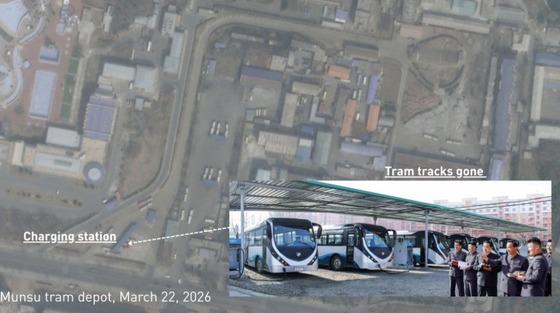
North Korea has reportedly discontinued its tram line in eastern Pyongyang and introduced electric buses, according to a recent analysis.
NK News, a U.S.-based media outlet focusing on North Korean affairs, reports that the country has begun phasing out trams that have been in service for over three decades, replacing them with electric buses in recent years.
The analysis, based on satellite imagery from Planet Labs, reveals that North Korean authorities have ceased operations on a 12-kilometer (about 7.5 miles) tram line, removed the tracks, and demolished the depot where trams were stored.
These changes were observed in satellite images between early February and late May of last year. Preparations for the transition, including the construction of charging stations for electric buses, began on October 17, 2024, and were completed by early November, indicating a methodical approach to the changeover.
It is believed that North Korean authorities are replacing trams with electric buses and trolley buses (trackless trams). The Choson Sinbo, the official newspaper of the General Association of Korean Residents in Japan, previously reported that this initiative aims to modernize the Munsu-Tosung line, which connects upscale residential areas in northeastern Pyongyang with the Nakhon area in the southwest.
Jacob Bogle, an expert on North Korean geography, suggests that the introduction of electric buses is part of a broader effort to showcase Pyongyang as a technologically advanced and modernized capital.
NK News also highlighted the potential involvement of China in North Korea’s electric vehicle production. The outlet reported that a Shanghai-based company has released photographs of charging equipment being installed at a trolley bus factory in Pyongyang.
This transition is not unprecedented; from 2014 to 2015, North Korea converted sections of its tram line between Mangyongdae and the Dongshin district west of Pyongyang to trolley buses. Currently, tram operations are limited to a 10-kilometer (about 6.2 miles) stretch between Mangyongdae Station and Pyongyang Station.