

Recently declassified diplomatic documents reveal that in the mid-1990s, South Korea and Israel sought to establish a joint government task force. This initiative, involving diplomatic, defense, and intelligence agencies, aimed to address North Korea’s suspected arms exports to the Middle East.
The Ministry of Foreign Affairs released 2,611 diplomatic documents on March 31, totaling over 37 million pages. These include records from the 3rd Korea-Israel Policy Consultation held in Jerusalem on November 22-23, 1995.
The Korean delegation included officials from the Ministry of Foreign Affairs, the Ministry of Trade, Industry and Energy, and the Embassy of the Republic of Korea in Israel. The Israeli side was represented by over ten members, led by the Director-General of the Foreign Ministry’s Asia Department.
During the meeting, Israeli officials proposed establishing a Joint Committee comprising Foreign and Defense Ministry personnel to coordinate responses to North Korea’s arms exports to the Middle East.
In response, the South Korean government began exploring the creation of a regular consultation body. This group would be led by the Foreign Ministry’s Director-General for Policy Planning and include representatives from relevant agencies such as the Ministry of Foreign Affairs, the Ministry of National Defense, and the Agency for National Security Planning (now the National Intelligence Service). The Israeli side’s proactive approach was particularly noteworthy.
On December 7, 1995, Ban Ki-moon, then Director-General for Policy Planning, met with Arie Arazi, the Israeli Ambassador to Korea. Arazi proposed naming the committee the Information Exchange Cooperation Committee and outlined Israel’s plans to include representatives from their Foreign Ministry, military intelligence, and Mossad. He noted that similar regular information exchange meetings were held between the U.S. and Israel.
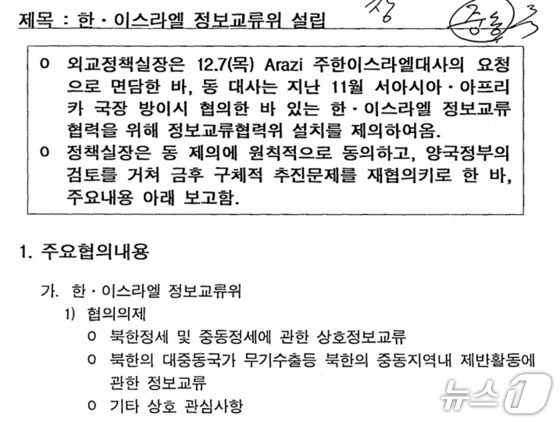
The Ministry of Foreign Affairs viewed the potential establishment of an information exchange committee with Israel as a valuable opportunity, given Israel’s advanced intelligence capabilities. They planned to propose the first exchange meeting for the following year, pending consultations with relevant departments and the Blue House.
The diplomatic documents also emphasized the need for strict confidentiality regarding these matters.
Israel, known for its military technological prowess, has developed advanced defense systems like the Iron Dome and the recently unveiled Iron Beam laser defense system. Moreover, Mossad’s intelligence capabilities are considered among the world’s best, second only to the United States. Their expertise has been crucial in recent Middle East crises, including operations against Iranian leadership.
While both nations could have benefited significantly from regular consultations on North Korean issues, it remains unclear whether this committee was ever formally established or if it continued operations.
A senior government source stated that if such a joint government committee were still active, it would have seen reports of officials visiting Israel over the past 30 years. However, it haven’t received any such information. Nevertheless, it’s understood that both countries maintain regular communication and cooperation through their intelligence agencies.
Since 1994, the Ministry of Foreign Affairs has been reviewing and releasing 30-year-old diplomatic documents to the public, in accordance with the Regulations on the Disclosure of Diplomatic Documents. To date, they’ve released approximately 40,000 documents (57 million pages) produced between 1948 and 1994. The newly released documents are available for public viewing in the Diplomatic Document Reading Room at the Diplomatic Archives.