

A recently declassified diplomatic document reveals that North Korea hinted at implementing China-style reform and opening policies during a Thai trade delegation’s visit in 1995. At the time, North Korea was in the throes of severe economic hardship known as the Arduous March. The document, released on Tuesday, shows that Pyongyang even explored long-term credit imports of grains, including rice, from Thailand.
The Ministry of Foreign Affairs made public key contents from 2,621 diplomatic documents (about 370,000 pages) that were declassified after 30 years. These documents include a report from the South Korean embassy in China detailing the outcomes of the Thai trade delegation’s North Korea visit in April 1995.
The documents state that the Thai trade delegation visited North Korea from April 17 to 22, 1995. This was a reciprocal visit following a North Korean economic delegation’s trip to Thailand in 1994. However, the Thai side reportedly showed little enthusiasm for the visit, as there were no significant economic or trade issues under discussion with North Korea at that time.
Thai officials who met with South Korean diplomats revealed that North Korea expressed interest in importing essential daily goods and requested credit imports with payment terms of 4 to 5 years. Notably, the Thai embassy in China reported that even after the delegation’s visit, North Korea frequently reached out regarding grain imports, particularly rice. However, the Thai government only approved credit imports for less than a year, citing that longer terms would require cabinet approval, effectively rejecting North Korea’s requests.
Faced with challenges in securing long-term credit imports, North Korea proposed providing its resources and raw materials in exchange for Thai goods. However, the Thai side deemed the quantities obtainable from North Korea insufficient, resulting in little progress in negotiations.
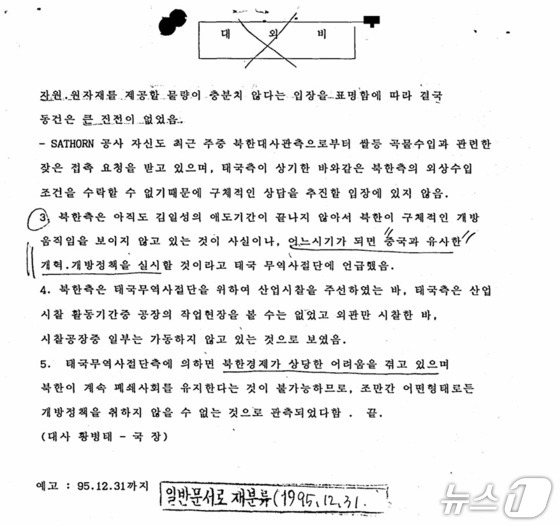
The sincerity of North Korea’s remarks about reform and opening at that time remains questionable. According to the diplomatic documents, North Korea told the Thai delegation that it couldn’t yet demonstrate concrete steps towards opening, as it was still in the mourning period for Chairman Kim Il Sung (who died in 1994). However, they also stated that at some point, they would implement reform and opening policies similar to China’s.
This could be interpreted as diplomatic rhetoric aimed at attracting external support to alleviate the immediate economic crisis. The Arduous March, which pushed North Korea to the brink of collapse, peaked in the late 1990s, resulting in hundreds of thousands of deaths from starvation. During this period, North Korea faced an existential crisis, and the country’s supreme leader at the time, Kim Jong Il, focused solely on strengthening military power through his military-first policy rather than pursuing reform and opening.
The Thai side reported to South Korea that based on their visit, North Korea was experiencing significant economic difficulties and that maintaining a closed society was no longer feasible. They predicted that North Korea would have to adopt some form of opening policy in the near future. Although North Korea arranged industrial visits for the delegation, the Thai delegates only observed the exterior of factories without seeing any internal operations, and they assessed that some factories appeared non-operational.