

Samsung Electronics announced on April 23 that it has developed groundbreaking display technology in partnership with POSTECH. This innovation allows users to effortlessly switch between high-resolution two dimensional (2D) images and immersive three dimensional (3D) visuals on a single screen, without the need for special glasses.
The research paper detailing this cutting-edge technology will be published in the world-renowned scientific journal Nature. Samsung Electronics emphasized that this achievement solidifies its global leadership in next-generation Meta optical devices and display technologies.
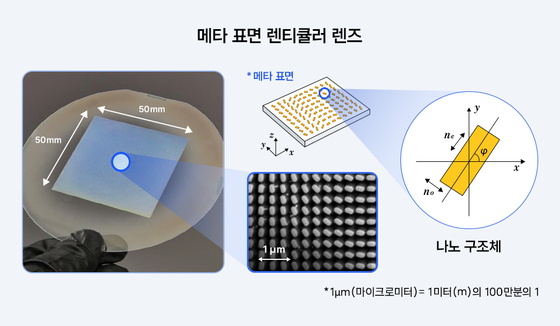
At the heart of this breakthrough is the Meta surface lenticular lens-based 2D-3D convertible display. This technology employs ultra-thin lenses with nanoscale structures to dynamically alter screen modes based on viewing conditions.
The Meta surface represents a significant leap forward, dramatically reducing thickness compared to conventional curved lenses while enabling complex optical functions. This makes it a potential game-changer for future display and camera systems.
While previous glasses-free 3D display technology, known as light field display, showed promise in fields like entertainment, augmented reality (AR), and medical imaging, it faced substantial hurdles to widespread adoption.
The main limitations were the thickness of the lenses, which made device slimming challenging, and a narrow 3D viewing angle of only about 15 degrees. This restricted the 3D effect to a fixed frontal position.
The joint Samsung Electronics and POSTECH research team overcame these obstacles by manipulating light polarization through innovative nanostructures.
In a world-first, the team designed and demonstrated a unique nanostructure called the Meta surface lenticular lens (MLL). This breakthrough allows the lens focus to shift simply by applying voltage to change the light’s direction.
The research’s most significant accomplishment is its simultaneous advancement in two critical areas of optical devices: thickness and viewing angle.
Conventionally, achieving high resolution and a wide viewing angle necessitates larger, thicker lenses. However, the research team maintained an incredibly slim 1.2 mm thickness while achieving a remarkable 100-degree ultra-wide viewing angle.
This represents more than a sixfold improvement over existing technology (15 degrees), paving the way for multiple viewers to enjoy 3D content simultaneously.
Notably, this research has progressed beyond theoretical concepts to reach a level suitable for practical application.
The team successfully produced a large-area Meta lens measuring 50 mm by 50 mm (25 cm²) and has validated its performance by directly applying it to organic light-emitting diode (OLED) display panels, which currently dominate the mobile market.