

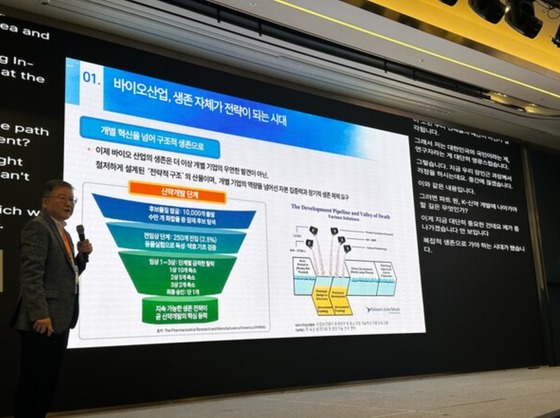
To emerge as global small giants, the pharmaceutical and biotech industries must break free from development focused on technology transfer and integrate into the global ecosystem.
These are the words of Dr. Park Young-min, Director of the Korea Drug Development Fund (KDDF). Dr. Park emphasized that the domestic drug development industry needs to move beyond competing on single technologies and instead focus on ecosystem-based structural competition.
On Tuesday, Dr. Park delivered a presentation titled, A New Engine for South Korea’s Economy: The Future of K-Bio Drug Development, at the 2026 HLB Forum: The DNA of Success, Continuous Innovation; Unstoppable Challenges, held at the Sofitel Ambassador Seoul in Songpa-gu.
Dr. Park observed that the global biotech industry has evolved from an era of simple technological rivalry into a strategic asset directly linked to national security and economic dominance. He noted that the U.S.-China tech rivalry presents both a challenge and a crucial opportunity for South Korea to emerge as a key player in the global value chain.
However, he pointed out that the biotech industry structure still heavily relies on technology transfer, lacking the experiential assets needed for global Phase 3 clinical trials and commercialization. Dr. Park stressed the need for structural transformation to achieve sustainable growth in the volatile biotech sector. He affirmed KDDF’s commitment to enhancing its role as a global partnering hub.
Dr. Park also highlighted the HLB Group, which is developing novel therapies for liver and bile duct cancers.
He emphasized China’s importance as a collaborative partner, noting the significance of HLB Group’s partnership with Anhui Jinling Pharmaceutical.
Dr. Park expressed confidence that HLB Group’s two decades of investment, passion, and experience would greatly benefit South Korea’s pharmaceutical industry and drug development efforts. He believes HLB Group will help overcome the challenge of limited global experience.
Drawing comparisons, Dr. Park noted that Switzerland and Denmark, despite their smaller size and population, host global giants like Roche, Novartis, and Novo Nordisk. There’s no reason for Korea to lag behind. He added optimistically that with the right policies and talent influx, it could see Korean big pharma emerge in the near future.
Since its 2021 launch, KDDF has supported the entire drug development cycle from candidate discovery to clinical trials, currently overseeing 553 projects. The organization views this as a pivotal moment and plans to refine its strategy in the second phase of operations beginning this year.
In this next phase, KDDF will shift focus from expanding existing projects to concentrating resources on pipelines with high global approval potential. While maintaining comprehensive support, it will prioritize projects most likely to advance to clinical trials.