

Kakao Mobility, the operator of Kakao Taxi, said it is building a large-scale autonomous agent ecosystem capable of integrating and operating a wide range of robots through its mobility platform.
The company aims to create consumer-facing robot services by allowing robots with different functions and designs to operate under a single platform while communicating seamlessly with users. Beyond delivery robots, which have already entered commercialization, the company plans to expand robot-based autonomous agents into cleaning, guidance and logistics services.
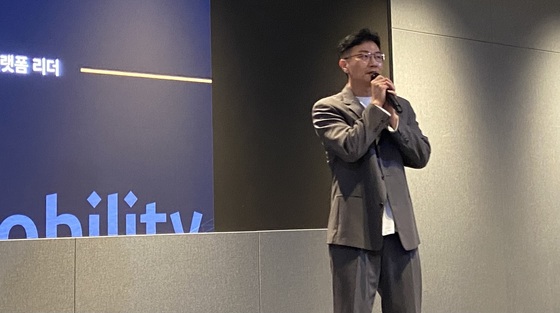
Speaking at a media event in Seongnam on May 12, Kang Eun-gyu, head of future business platforms at Kakao Mobility, said robot platforms are evolving beyond simple monitoring systems.
“In the past, platforms merely supervised robots, but now they assign tasks, integrate robot infrastructure within buildings and communicate directly with users,” Kang said.
He described Kakao Mobility’s ability to flexibly integrate various types of robots into one platform as the company’s core competitive advantage.
“A robot platform should function like the conductor of an orchestra,” Kang said. “We have established a standard that allows any robot to control infrastructure through a single communication link with Kakao Mobility’s server.”
Kakao Mobility is currently defining a standardized application programming interface, or API, framework that would allow robots developed under the standard to connect easily with the platform regardless of model or form factor.
Kang added that the company is strengthening technologies that help robots collaborate with humans, including building control systems that manage robot operations inside facilities and systems that monitor robots’ work status and readiness for human handoff.

Kakao Mobility said it ultimately plans to evolve its robot platform into a fully autonomous agent ecosystem in which the platform itself helps complete services between on-site operations and robotic execution systems.
The company said the platform would handle unexpected situations, such as when a customer fails to pick up a delivery or when a robot stops during operation, ensuring service continuity.
Oh Doo-yong, head of robot development at Kakao Mobility, said that while robot hardware is advancing rapidly, robots alone cannot fully manage complex real-world operating environments.
“The platform must bridge the gap between field operations and robotic systems by integrating the entire on-site robot ecosystem,” Oh said.
He added that Kakao Mobility has already directly integrated elevators into its platform, allowing robots to independently move between floors and control boarding and exiting functions.
The company plans to expand robot-based autonomous agents into cleaning, guidance and logistics services while broadening platform integration beyond building systems into logistics infrastructure.
Its delivery robot model has already entered commercialization. The company’s “BRING” delivery robot, developed in partnership with robotics company Robotis in 2024, has been deployed at more than 10 hotels and hospitals across South Korea.
Kakao Mobility said hotels using the robots alongside QR-code ordering systems have seen room-service sales roughly triple.
Oh said the company intends to lead an open robot ecosystem by building APIs that support interoperability among different robot hardware systems.
“We plan to expand platform connectivity beyond indoor delivery robots to all forms of autonomous mobility devices,” he said.