

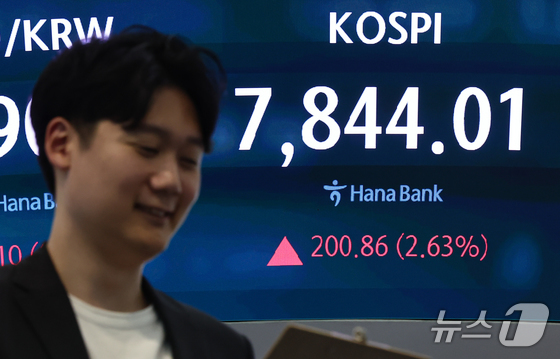
The Nihon Keizai Shimbun reported on Thursday that as the KOSPI index nears 8,000, American institutional and retail investors are increasingly flocking to the Korean stock market.
Over the past year, the KOSPI index has tripled, propelled by surging memory prices due to the artificial intelligence (AI) industry boom. Stocks of companies like SK Hynix and Samsung Electronics have seen remarkable gains.
However, the paper noted that SK Hynix and Samsung Electronics still maintain a projected price-to-earnings ratio (PER) of around six, lower than their competitor Micron Technology’s PER of nine.
At the Son Investment Conference on Tuesday, Eduardo Marques of Patently Partners stated taht he’s hooked on uncovering the complex value investment opportunities hidden in Korean stocks.
He added that the PER gap between SK Hynix, Samsung, and Micron is well-recognized in Western markets, suggesting significant buying opportunities at lower prices.
Jonathan Lennon from Pleasant Lake Partners is closely examining Korean consumer stocks, particularly intrigued by Samsung’s consideration of a 10% operating profit bonus for employees.
Lennon estimates that the combined bonuses from both companies could reach 40 billion USD, a substantial portion of Korea’s gross domestic product (GDP), potentially creating unprecedented economic ripple effects.
U.S. retail investors are also jumping on the Korean stock market bandwagon. Roundhill, an American asset management firm, recently launched a memory stock exchange-trade fund (ETF) that attracted over 6 billion USD in just over a month.
This fund accumulation rate outpaces even the 2024 Bitcoin ETFs, setting a new record. The ETF’s portfolio is heavily weighted towards Samsung Electronics and SK Hynix, comprising nearly half of its holdings.
In a related development, U.S. online brokerage Interactive Brokers began offering direct trading of Korean Exchange-listed stocks on May 7.
Marques expressed his interest in Korean stocks, noting that even for AI believers, U.S. stock valuations look steep. Korean stocks present an attractive alternative.