

Researchers in South Korea have proposed a new form of interaction that allows humans to engage emotionally with nonhuman beings such as plants and animals.
KAIST said Thursday that a research team led by Professor Lee Chang Hee from the Department of Industrial Design received a Best Paper Award at Association for Computing Machinery CHI 2026, a leading international conference in the field of human-computer interaction (HCI), for a study that treated plants not as decorative objects or sensors, but as active participants in interaction.
The Best Paper Award is given to roughly the top 1% of submitted papers. This year’s conference drew a record 6,730 submissions, highlighting the global competitiveness of the KAIST research team.
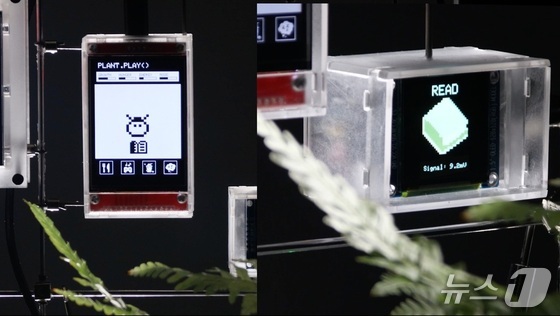
Through a paper titled “What If Plants Could Play Games?”, the team proposed a new interaction model in which plants directly participate in digital gameplay.
Unlike previous approaches that used plants mainly as sensors or decorative elements, the study was designed so that changes in a plant’s condition directly affected how the game progressed.
The researchers incorporated plants’ bioelectrical signals, environmental data and circadian rhythms — biological changes that repeat according to day and night cycles — into the gameplay system, allowing in-game characters to evolve based on the plant’s condition.
The plant-linked digital pet evolved while displaying a range of behaviors, including reading books and dancing. The character’s appearance and development changed in diverse ways depending on the plant’s growth and surrounding environment.
Rather than directly controlling the game, users participated by observing and interpreting the plant’s responses and gradual changes.
The research team conducted user studies in a real exhibition setting and found that participants embraced the plants’ slow and unpredictable changes as a form of play.
Participants also showed emotional immersion and empathy toward both the plants and the virtual characters in the game, suggesting that users came to perceive plants not simply as passive objects of observation but as entities capable of interaction.
The study received praise for moving beyond conventional human-centered digital interaction and presenting new possibilities for engaging with nonhuman beings such as plants.
The researchers said the findings could open new possibilities in future game development and design, while also expanding into exhibitions, education, wellness experiences and mindfulness tools based on slow interaction.
“This study was an attempt to explore new forms of interaction by viewing nonhuman beings such as plants as active agents,” Lee said. “In the future, interaction not only with humans but also with AI, robots, animals and plants will become increasingly important.”
Doctoral researcher Lee Yoon Ji participated as the paper’s first author, while Professor Lee served as the corresponding author. The paper is available through the ACM Digital Library.