

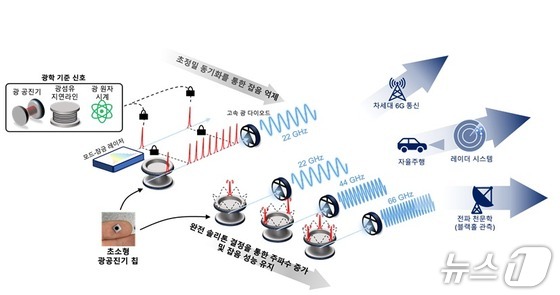
The Korea Advanced Institute of Science and Technology (KAIST) announced a breakthrough in generating ultra-low noise and ultra-stable millimeter-wave (30-300 GHz) signals. This achievement comes from a collaborative effort between Professor Kim Jeong-won’s team from the Department of Mechanical Engineering and Professor Lee Han-seok’s team from the Department of Physics, utilizing an optical chip technology known as Microcom.
Millimeter waves are emerging as a crucial frequency band for 6G communication, precision sensing, and next-generation radar technology, thanks to their wide bandwidth capabilities. However, conventional electronic signal sources have struggled with increasing noise at higher frequencies and maintaining long-term stability.
Microcom, a millimeter-sized optical device, creates highly precise light cycles. Often compared to an ultra-precise optical ruler, it offers precise frequency standards while operating with low power in a compact form. Despite its excellent low-noise characteristics at low repetition rates, it has faced challenges in maintaining performance when expanding into high-frequency ranges.
The research team’s first study tackled the persistent issue of long-term frequency drift by implementing a synchronization technique. This method aligns a highly precise optical reference signal with the Microcom.
The team achieved remarkable results, including ultra-stable frequency performance at the 10^-18 level over extended periods and low phase noise of -125 dBc/Hz at a 100 Hz offset in the 22 GHz band.
This performance sets a new global standard for Microcom-based signal sources in the low offset frequency range. The technology shows promise for applications in 6G communication, precision radar, and next-generation aerospace electronic systems where high frequency stability and precision are critical.
In their second study, the researchers successfully extended the signal into the millimeter-wave band while preserving ultra-low noise characteristics. They overcame the typical challenge of increased signal fluctuations at higher frequencies by employing a unique physical state called complete soliton crystals.
Traditionally, higher frequency signals become less stable and noisier. However, the team managed to minimize fluctuations even in faster high-frequency signals by harnessing the complete soliton crystal state, which organizes light pulse waveforms with exceptional regularity.
The potential commercialization of this technology could revolutionize ultra-fast communication by enhancing data transmission reliability. It also promises significant improvements in the accuracy of distance and speed measurements for radar applications in autonomous driving and defense sectors.
Professor Kim emphasized the significance of their work, stating that the research has not only elevated Microcom-based signal sources to world-class performance levels but also extended their application into high-frequency ranges. He added that their current focus is on pushing the boundaries even further, exploring frequencies above 100 GHz and even venturing into sub-millimeter waves beyond 300 GHz.
The groundbreaking research, spearheaded by Dr. Ahn Chang-min and Professor Kim Jeong-won, with Professor Lee Han-seok as a co-author, has been published in prestigious international optical journals: Laser & Photonics Reviews and Optica.
This innovative study received support from key national research institutions: the National Research Foundation (NRF), the Institute of Information and Communications Technology Planning and Evaluation (IITP), and the National Science and Technology Research Council (NST).