

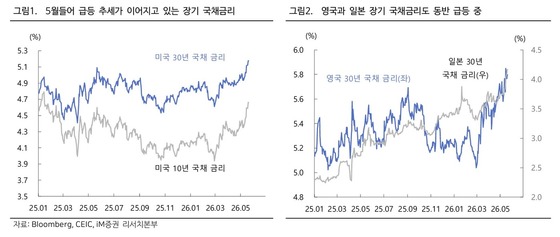
A phenomenon known as rate shock is spreading across the U.S. and other major economies, with long-term government bond yields soaring. iM Securities analysts suggest that risks related to Iran and policy uncertainties are fueling market anxiety. They warn that rising global oil prices and increasing inflation expectations are contributing to a vicious cycle of high oil prices, high inflation, and high interest rates.
On Wednesday, Park Sang-hyun, a researcher at iM Securities, noted that global government bond yields are showing signs of panic selling, particularly in long-term bonds, and this surge is spreading rapidly. The risk of panic selling in long-term government bonds could further amplify asset price volatility.
At the close of trading on Tuesday, the yield on U.S. 30-year Treasury bonds reached 5.1785%. During the session, it surged to 5.197%, surpassing the October 2023 peak of 5.1829% and marking the highest level since July 2007, just before the global financial crisis.
This sharp rise in long-term government bond yields is not limited to the U.S. but is also occurring in other major economies. Market sentiment suggests growing concerns that this upward trend may persist for some time.
Park identified geopolitical risks related to Iran and political and policy uncertainties as the main factors behind the surge in long-term yields. He explained that while various factors are at play, the overarching issues are the uncertainties surrounding Iran and the broader policy landscape.
On a positive note, there are currently no signs of short-term liquidity tightening. The balance of the Federal Reserve’s reverse repurchase agreements (RRP), considered an indicator of excess liquidity in the U.S. financial system, has increased for two consecutive days. Additionally, the Secured Overnight Financing Rate (SOFR), the benchmark interest rate in the U.S. short-term funding market, continues to trend downward.
However, Park cautioned that the fatigue from the prolonged Iran risk is becoming evident in the Treasury bond market. He added that if global oil prices rise further, the instability in the Treasury market could spill over into other financial markets.
He continued that if tensions between the U.S. and Iran escalate again, it could see a scenario of rising oil prices leading to soaring inflation expectations and further increases in Treasury bond yields or early rate hikes from major central banks becoming more likely. Park concluded that ultimately, resolving the uncertainties related to Iran will be crucial for market stability.