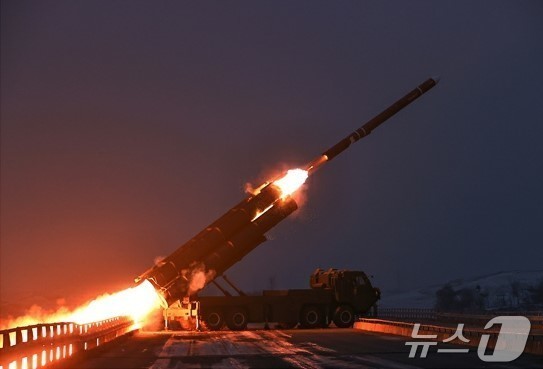
North Korea said May 27 that the missile launches carried out the previous day were tests of new tactical weapons intended for forward deployment against South Korea.
Analysts say Pyongyang appears to be shifting its operational strategy away from conventional “mass artillery bombardment” tactics toward large-scale use of ballistic missiles capable of simultaneously carrying out precision strikes on key South Korean military bases, weapons systems and command facilities in both frontline and rear areas, as it accelerates the “modernization” of its frontline corps.
North Korea claimed the tests verified the power of a new warhead for tactical ballistic missiles, or short-range ballistic missiles, the performance of an ultra-precise autonomous guidance and navigation system for extended-range 240-millimeter guided rockets, and the targeting accuracy of artificial intelligence-guided tactical cruise missiles.
North Korea unveils AI-enhanced tactical cruise missile for first time
The tactical cruise missile disclosed by North Korea for the first time is viewed as a short-range tactical weapon designed for multiple-launch operations by frontline units, unlike the medium-range strategic cruise missiles the country has previously deployed.
North Korea said it applied a “terrain contour matching navigation system” to the tactical cruise missile, a technology that inputs terrain data into the missile’s navigation system so it can fly according to geographical features.
Analysts said the feature is intended to allow the missile to maintain stable flight even in mountainous areas near the inter-Korean border, reflecting the characteristics of cruise missiles that fly at low altitudes to carry out stealth strikes.
North Korea also claimed the cruise missile was equipped with AI-based terminal guidance capabilities.
Experts said the technology appears intended to improve strike precision by enabling the missile to automatically recognize pre-learned “high-value targets” during the final phase of flight.
If weapons systems such as transporter erector launchers, or TELs, and tanks are designated as strike priorities during training, the missile could automatically identify and attack priority targets once it reaches the target area.
Analysts said the capability resembles the “loitering precision-guided weapon,” or L-PGW, currently under development by Hanwha Aerospace for South Korea’s military.
The concept involves a missile using AI-based learning to assess the value of targets while loitering in the air before striking priority assets.
Analysts believe North Korea aims to use the cruise missile in wartime to strike key South Korean weapons systems concealed near the inter-Korean border immediately after they are exposed.
North Korea also unveiled for the first time a “lightweight multi-purpose missile launch system” capable of launching both 240-millimeter guided rockets and tactical ballistic missiles from a single launcher.
The system would allow operators to launch multiple rockets or a short-range ballistic missile intended for what North Korea described as a “decisive strike,” depending on operational needs.
After observing the tests, Kim Jong Un, general secretary of the Workers’ Party, said, “The important weapons system tests conducted today are a clear signal of the renewal of our military capabilities,” adding that “our firepower systems have now been fully equipped with automation, long-range capability and ultra-precision.”
Kim also expressed confidence in the performance of the modernized frontline weapons systems, saying, “It is an essential requirement for our military operations to possess destructive power so overwhelming that the opposing forces would theoretically be unable to survive.”
Shift from indiscriminate long-range artillery attacks toward precision strikes with advanced weapons
Experts said North Korea appears to be shifting away from its previous strategy of using long-range artillery for indiscriminate attacks on the Seoul metropolitan area and instead moving toward precision and concentrated strikes on key South Korean and U.S. military bases, command facilities and other critical infrastructure using modernized weapons systems.
That would enable attacks targeting not only frontline areas but also South Korea’s rear areas.
Hong Min, a senior research fellow at the Korea Institute for National Unification, said, “North Korea is comprehensively modernizing its tactical strike systems toward precision, long-range capability and automation,” adding, “There is a clear trend toward operating multiple rocket launchers, tactical cruise missiles and tactical ballistic missiles as a unified precision-strike complex.”
Hong added, “As launch sites move closer to the Military Demarcation Line, flight times become shorter and the window for detection and interception also shrinks,” noting that simultaneous operation of multiple rocket launchers, cruise missiles and tactical ballistic missiles by frontline North Korean units could place significant strain on South Korea’s Korea Air and Missile Defense system, or KAMD, and the Long-range Artillery Interception System, or LAMD.
He said simultaneous launches of low-flying cruise missiles, rockets and tactical ballistic missiles could make pre-detection and interception significantly more difficult.
Shin Jong-woo, secretary-general of the Korea Defense Security Forum, said North Korea’s newly unveiled “lightweight multi-purpose missile launch system” is conceptually similar to South Korea’s Cheonmu system and the U.S. High Mobility Artillery Rocket System, or HIMARS, which can operate rockets and tactical ballistic missiles from a single launcher. He added that the system would likely enable rapid reloading and maneuverability by allowing various types of munitions to be swapped in pod form.
Experts said North Korea appears to view precision-strike capabilities for conventional missiles as increasingly important alongside the advancement of its nuclear weapons program following the outbreak of the war in Ukraine. Analysts expect Pyongyang, which has declared the two Koreas to be separate states and has been fortifying border regions, to further strengthen its strategy of overwhelming South Korea in the early stages of a conflict by concentrating more advanced weapons systems in frontline areas.