

President Lee Jae Myung Outlines Approach to North Korea’s Denuclearization
On Monday, President Lee Jae Myung addressed North Korea’s denuclearization issue, proposing short-term negotiation goals: halting additional nuclear material production, preventing overseas export of nuclear materials, and suspending intercontinental ballistic missile (ICBM) technology development.
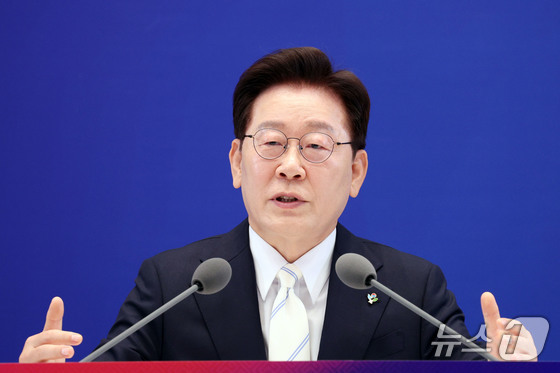
He presented this strategy during a press conference at the Blue House’s State Guesthouse, marking his first year in office. Lee advocated for a phased approach, suggesting North Korea pause nuclear material production and missile development for a set period before complete denuclearization.
Lee defended his stance, stating that claiming it has abandoned denuclearization is irresponsible and worsens the situation by ignoring reality. He mentioned sharing this perspective with former U.S. President Donald Trump multiple times.
The President emphasized the need for realism, urging dialogue with short, medium, and long-term objectives. It must not give up on negotiations, he stressed.
Regarding inter-Korean relations, Lee affirmed commitment to the constitutional path, stating that it cannot abandon the goal of peaceful reunification.
He described current relations as unlikely to deteriorate further, drawing a parallel with Chinese President Xi Jinping’s remark about ice not melting in a day.
Lee insisted that it can’t give up; it would be detrimental. He argued that 70 years of division is not insurmountable from a historical perspective.
The President reiterated the need to follow the constitutional path, emphasizing ongoing dialogue and normalizing relations with neighboring countries.
In his opening remarks, Lee pledged to advance peace and stability on the Korean Peninsula, guided by the principle that peace is growth, and peace is livelihood.
He outlined his second-year goal of strengthening South Korea’s global diplomatic and security standing, promising to build on achievements like revising the Korea-U.S. nuclear agreement, introducing nuclear submarines, and pursuing early restoration of wartime operational control.
Lee committed to enhancing South Korea’s role as a responsible global power, based on a strong U.S. alliance, robust self-defense, and pragmatic diplomacy serving national interests.
Addressing the Korea-Japan Mutual Military Support Agreement (ACSA), Lee acknowledged its practical necessity but noted current public reluctance. He stressed the need to resolve historical issues fundamentally before strengthening military cooperation.
The President recounted telling Japanese Prime Minister Sanae Takaichi his desire to transform Korea-Japan relations from close yet distant to close and closer.
Lee used an analogy: If someone punches you, you can’t just brush it off and be friends. It may cooperate out of necessity, but can it truly collaborate fully?
He emphasized the importance of sincere apology and emotional resolution, beyond financial compensation.
Regarding the HMM Namoo ship incident, Lee confirmed it was struck by a suspected Iranian missile but stated that it’s clear this wasn’t intentional.
He noted the oddity of the minor damage, explaining that normally, a missile strike would sink a ship, but this only caused a slight explosion.
Lee revealed that while Iran denies responsibility, South Korea believes it was likely their missile and has lodged a serious protest, demanding preventive measures.
Lastly, addressing his criticism of the Israeli military, Lee explained that as South Korea’s leader, he felt compelled to speak out against human rights violations affecting Korean citizens.
He stated that there have been human rights abuses against the citizens, and he couldn’t ignore that issue.
This statement underscores Lee’s commitment to protecting Korean interests on the global stage.
The President’s remarks reflect a nuanced approach to international relations, balancing diplomatic necessities with moral imperatives and national interests.